 +91 253 6630710
 781.258.1274
 +44 (0) 7446 87 37 97
Multi-Cloud vs Hybrid Cloud — What Enterprises Are Choosing in 2026


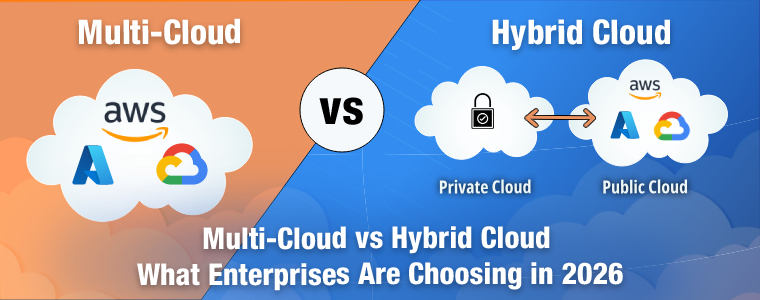
Multi-Cloud vs Hybrid Cloud — What Enterprises Are Choosing in 2026
Cloud adoption has matured significantly over the past decade. Enterprises are no longer debating whether to adopt the cloud; instead, they are refining how to structure their cloud architecture for performance, scalability, and resilience. As digital transformation accelerates across industries, organizations are increasingly evaluating two dominant strategies: multi-cloud and hybrid cloud.
Both approaches allow businesses to optimize infrastructure and reduce dependency on a single vendor. However, they serve different purposes and require different operational models. In 2026, enterprises are strategically combining these approaches to build resilient and scalable environments powered by modern cloud services and cloud development services.
Highlights:
- Hybrid cloud combines private infrastructure with public cloud services for security and scalability.
- Multi-cloud uses multiple cloud service providers to avoid vendor lock-in.
- Hybrid cloud supports compliance and legacy systems.
- Multi-cloud improves flexibility, reliability, and performance.
- In 2026, enterprises are adopting hybrid multi-cloud strategies.
- Cloud development services enable modern, cloud-native applications.
- Cloud consulting and managed services help manage complex environments.
- Platforms like Azure cloud services simplify hybrid and multi-cloud deployments.
Understanding Hybrid Cloud Architecture
A hybrid cloud environment integrates on-premise infrastructure or private cloud environments with public cloud platforms. This model enables organizations to maintain control over sensitive data while leveraging the scalability and flexibility of public cloud computing services.
Many enterprises still rely on legacy applications or sensitive databases that cannot easily be migrated to the public cloud. Hybrid cloud enables them to modernize gradually without disrupting existing operations.
Key Benefits of Hybrid Cloud
1. Compliance and Data Security
Industries such as healthcare, finance, and government must comply with strict regulatory requirements. Hybrid cloud allows organizations to keep critical data on private infrastructure while using public cloud services for less sensitive workloads.
2. Seamless Legacy Integration
Enterprises often operate mission-critical legacy systems that are difficult to migrate. Hybrid environments allow these systems to remain operational while new applications are built using modern cloud development services.
3. Business Continuity and Disaster Recovery
Hybrid environments improve resilience by enabling organizations to use the public cloud as a backup or failover environment.
4. Controlled Cloud Migration
Hybrid architecture provides a transitional model for organizations gradually adopting enterprise cloud services.
Because of these advantages, hybrid cloud remains highly relevant for enterprises managing complex IT ecosystems.
Understanding Multi-Cloud Strategy
A multi-cloud strategy involves using multiple public cloud providers simultaneously rather than relying on a single vendor. Enterprises distribute workloads across different platforms to leverage the strengths of each provider.
For example, an organization might run analytics workloads on one provider, application hosting on another, and AI services on a third platform. This approach allows companies to select the best technology stack while optimizing cloud costs and performance.
Advantages of Multi-Cloud
1. Avoiding Vendor Lock-In
Using multiple cloud service providers reduces dependency on a single vendor and improves negotiation leverage.
2. Access to Best-of-Breed Services
Different providers excel in areas such as artificial intelligence, analytics, or container orchestration. Multi-cloud environments enable enterprises to combine the most advanced cloud computing services available.
3. Improved Reliability
Distributing workloads across multiple providers reduces the risk of service disruption due to outages.
4. Global Infrastructure Coverage
Organizations can deploy applications in multiple regions using different providers to deliver better performance to global users.
As businesses expand their digital infrastructure, multi-cloud strategies are becoming central to modern enterprise cloud services.
Hybrid Cloud vs Multi-Cloud: Key Differences
While both strategies enhance flexibility and scalability, they address different operational requirements.
| Factor | Hybrid Cloud | Multi-Cloud |
|---|---|---|
| Infrastructure Model | Private infrastructure + public cloud | Multiple public cloud providers |
| Primary Goal | Compliance, legacy integration | Vendor diversification |
| Complexity | Moderate | Higher operational complexity |
| Data Control | High control over sensitive workloads | Depends on provider architecture |
| Use Case | Gradual cloud adoption | Performance optimization and redundancy |
Enterprises often evaluate these models based on security requirements, cost considerations, and application architecture.
What Enterprises Are Choosing in 2026
In practice, most organizations are not choosing one approach over the other. Instead, they are implementing hybrid multi-cloud environments.
This architecture combines:
- Private infrastructure for sensitive workloads
- Multiple public cloud platforms for scalability
- Cloud-native applications developed through cloud development services
Several factors are driving this shift.
1. AI-Driven Workloads
Artificial intelligence, machine learning, and analytics workloads require scalable computing environments. Enterprises often deploy these applications across multiple cloud computing services.
2. Regulatory Compliance
Many regions enforce strict data sovereignty regulations. Hybrid architectures allow companies to maintain compliance while benefiting from public cloud services.
3. Application Modernization
Modern applications are increasingly built using containers, Kubernetes, and microservices. These architectures make it easier to deploy applications across hybrid and multi-cloud environments.
4. Cost Optimization
Enterprises are adopting FinOps practices to manage cloud spending. Multi-cloud strategies enable organizations to optimize pricing across different providers.
The Role of Cloud Consulting and Managed Services
Designing and managing hybrid or multi-cloud environments requires deep expertise in architecture, security, networking, and automation. Many enterprises rely on experienced partners that provide cloud consulting services and cloud managed services.
These providers help organizations:
- Design scalable enterprise cloud architectures
- Migrate legacy systems to modern platforms
- Build applications using cloud development services
- Optimize infrastructure performance and costs
- Provide continuous monitoring and operational support
Partnering with experienced cloud computing service providers allows enterprises to accelerate cloud adoption while minimizing operational risks.
The Role of Azure Cloud Services in Hybrid Environments
Among major platforms, Azure cloud services are widely used in hybrid cloud environments due to their strong integration capabilities.
Solutions such as Azure Arc and Azure Stack enable organizations to extend Azure services to on-premise infrastructure and edge environments. This makes Azure a powerful platform for companies implementing hybrid and multi-cloud strategies.
Combined with specialized Azure cloud consulting services, enterprises can deploy workloads across environments while maintaining centralized governance, security, and compliance.
Conclusion
As enterprises continue their digital transformation journey, cloud strategy has become a critical factor in long-term success. Hybrid cloud and multi-cloud architectures both offer unique advantages, and in 2026, most organizations are adopting a combination of the two.
Hybrid cloud enables businesses to maintain control over sensitive workloads, while multi-cloud environments provide flexibility, innovation, and resilience. Together, these strategies allow enterprises to maximize the value of modern cloud services.
With the right expertise in cloud development services, consulting, and managed infrastructure, organizations can build scalable cloud ecosystems that support innovation, operational efficiency, and global growth.
 Few
More from
Administrator
Few
More from
Administrator
Category: Digital
Recent Posts
-
Digital
AI vs AI: How Enterprises Can Defend Against the New Generation of AI-Powered Cyberattacks
-
Digital
Cybersecurity Awareness Month 2026: How to Benchmark Your Enterprise Security Posture
-
Digital
Cybersecurity Awareness Month 2026: What Should Be on Every Enterprise Security Checklist?
-
ServiceNow
ServiceNow Otto Explained: What the New AI Assistant Means for Enterprise Work in 2026
-
Digital
Small Business Website Security: How to Protect Your Site and Customer Data