 +91 253 6630710
 781.258.1274
 +44 (0) 7446 87 37 97
Salesforce Implementation Checklist: 10 Non-Negotiables for Success in the Agentic Era


Salesforce Implementation Checklist: 10 Non-Negotiables for Success in the Agentic Era
Blog Highlights:
- Discover the 10 non-negotiables that separate successful Salesforce implementations from costly failures.
- Learn how the Agentic Era is reshaping Salesforce projects with AI-powered agents and intelligent automation.
- Understand why business outcomes, clean data, and executive sponsorship are critical before implementation begins.
- Explore best practices for Agentforce readiness, data governance, integrations, and AI security.
- Learn how a phased, composable implementation strategy reduces risk and accelerates ROI.
- Discover practical tips to improve user adoption, change management, and long-term platform success.
- Understand how to budget for the total cost of ownership (TCO) beyond Salesforce licensing.
- Learn why continuous optimization after go-live is essential for maximizing Agentforce and AI investments.
- Find out what to look for when choosing a Salesforce implementation partner in the age of AI.
- Get actionable insights from Aress Software's implementation experience helping organizations build future-ready Salesforce ecosystems.
The Agentic Era is here. With Agentforce and autonomous AI agents transforming how businesses operate, a Salesforce implementation is no longer just a CRM rollout - it's the foundation for an intelligent, agent-powered enterprise.
Many organizations still treat implementation as a technical project and later struggle with low adoption, unreliable AI, ballooning costs, or limited ROI. At Aress Software, we've guided dozens of implementations through this shift. Here's our battle-tested 10 Non-Negotiables checklist to ensure success in 2026 and beyond.
1Define Clear Business Outcomes (Not Just Features)
Non-Negotiable: Start with measurable goals tied to revenue, efficiency, customer experience, or cost savings. Why it matters in the Agentic Era: AI agents need clear direction. Vague objectives lead to generic configurations that fail to power effective agents.
Action Items:
- Align stakeholders on KPIs (e.g., "Reduce sales cycle by 25%" or "Cut service resolution time by 40%").
- Create a business value map linking Salesforce capabilities (including Agentforce) to outcomes.
- Avoid the trap: "We want everything in Sales Cloud + AI."
2Establish Strong Executive Sponsorship and Governance
Non-Negotiable: Secure active C-level involvement and a cross-functional governance team from day one. Why it matters: Agentforce spans departments. Without sponsorship, adoption and scaling collapse.
Action Items:
- Appoint a dedicated Salesforce Champion at the executive level.
- Form a governance board for decisions on customizations, AI agents, and data policies.
3Prioritize Data Quality and 3600 Customer View
Non-Negotiable: Treat data as the fuel for AI. Clean, unify, and govern it before migration. Why it matters: Poor data = unreliable Agentforce outputs and "hallucinations" in production.
Action Items:
- Run a thorough data audit and cleansing exercise.
- Implement Data Cloud (or equivalent) for real-time unification.
- Establish ongoing data governance policies.
4Design a Phased, Composable Implementation Roadmap
Non-Negotiable: Avoid big-bang rollouts. Use a phased approach with composable architecture. Why it matters: The Agentic Era demands agility. Rigid systems become obsolete quickly.
Action Items:
- Phase 1: Core CRM + data foundation.
- Phase 2: Agentforce pilots in high-impact areas (e.g., Service or Sales agents).
- Build with reusability and scalability in mind.
5Plan Integrations Early and Thoughtfully
Non-Negotiable: Map all required integrations (ERP, marketing, legacy systems) during discovery. Why it matters: Agents need access to complete, real-time data across the enterprise.
Action Items:
- Use MuleSoft or native connectors strategically.
- Define data ownership and sync rules to prevent silos.
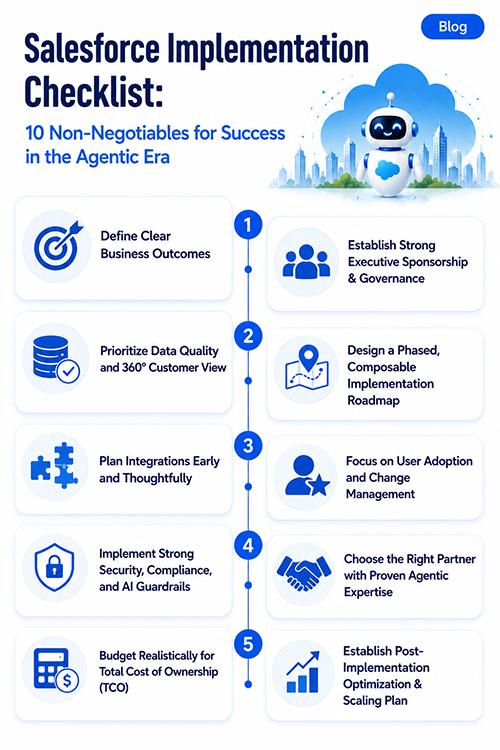
6Focus on User Adoption and Change Management
Non-Negotiable: Invest heavily in role-based training and change management. Why it matters: Even the best AI agents fail if humans don't trust or use the platform.
Action Items:
- Deliver hands-on, role-specific training (including how to work alongside agents).
- Create internal champions and feedback loops.
- Monitor adoption metrics weekly post-launch.
7Implement Strong Security, Compliance, and AI Guardrails
Non-Negotiable: Build security and ethical AI controls into the foundation. Why it matters: Agentforce introduces new risks around data privacy, bias, and autonomous actions.
Action Items:
- Follow Salesforce's Agentforce security best practices.
- Define clear escalation paths from agents to humans.
- Ensure compliance with industry regulations (GDPR, HIPAA, etc.).
8Choose the Right Partner with Proven Agentic Expertise
Non-Negotiable: Work with a Salesforce implementation partner experienced in both classic implementations and AI/agent deployments. Why it matters: The complexity has increased significantly in 2026.
Action Items:
- Evaluate partners on industry experience, certifications, and recent Agentforce case studies.
- Demand a clear methodology and post-go-live support plan.
9Budget Realistically for Total Cost of Ownership (TCO)
Non-Negotiable: Plan beyond licenses for data work, training, integrations, AI development, and ongoing optimization. Why it matters: Hidden costs frequently derail ROI in AI-enhanced projects.
Action Items:
- Build a 12-24 month TCO model.
- Include contingency for iterative AI agent enhancements.
10Establish Post-Implementation Optimization & Scaling Plan
Non-Negotiable: Treat go-live as the beginning, not the end. Why it matters: Agentforce value grows through continuous tuning and expansion.
Action Items:
- Schedule 30/60/90-day optimization reviews.
- Set up monitoring for agent performance and business KPIs.
- Plan for expansion to additional clouds or use cases.
Final Thoughts from Aress Software
In the Agentic Era, successful Salesforce implementations are those that treat technology as an enabler of intelligent business processes - not an end in itself. Organizations that follow these 10 non-negotiables consistently achieve higher adoption, faster time-to-value, and stronger returns on their AI investments.
Ready to future-proof your Salesforce journey? Aress Software offers complimentary Salesforce Maturity Assessments and Agentforce Readiness Workshops. You can read more about our insights and services in our blog.
FAQs
How is a Salesforce implementation different in the Agentic Era with Agentforce?
It's no longer a feature-led CRM rollout; it's the operating foundation for an agent-powered enterprise. Success hinges on business outcomes, clean data, phased delivery, and cross-functional governance. In practice, that means:
- Start from measurable outcomes (e.g., reduce sales cycle by 25%, cut service resolution time by 40%) and map Salesforce + Agentforce capabilities to those KPIs.
- Build composably and phase delivery to stay agile as AI use cases evolve.
- Treat data as fuel for reliable agents; unify and govern it before migration.
- Put executive sponsorship, security, and change management at the core so agents are trusted and adopted.
What executive sponsorship and governance do we need, and why?
Agentforce spans departments and introduces new decisions (customizations, agent behaviors, data policies). Without active sponsorship, adoption and scaling stall. You need:
- A C-level Salesforce Champion who owns outcomes and clears roadblocks.
- A cross-functional governance board to prioritize work, approve customizations/agents, and set data/AI policies.
- Clear escalation paths from agents to humans and decision rights that align to business value. This structure keeps priorities aligned to KPIs, reduces sprawl, and sustains momentum beyond go-live.
How do we prepare data for reliable Agentforce and a 3600 customer view?
Treat data quality as non-negotiable. Poor data produces unreliable outputs and "hallucinations." Do the following before migration:
- Run a data audit and cleansing effort across sources (ERP, marketing, legacy systems).
- Implement Data Cloud (or equivalent) for real-time unification and identity resolution.
- Define data ownership, sync rules, and ongoing governance policies.
- Establish quality monitoring so agents consistently act on trusted, current information.
What does a phased, composable roadmap look like, and how do we choose pilot areas?
Avoid big-bang deployments. Use iterative phases that deliver value quickly and de-risk AI:
- Phase 1: Core CRM + data foundation to enable accurate, real-time context.
- Phase 2: Agentforce pilots in high-impact domains (e.g., Service triage, Sales prospecting) tied to clear KPIs.
- Plan integrations early (MuleSoft or native connectors) and define ownership/sync rules to avoid silos.
- Build reusable components and measure pilot outcomes to inform scaling.
How should we budget and operate post-go-live to realize ROI?
Model total cost of ownership over 12-24 months and treat go-live as day one of optimization:
- Budget beyond licenses for data work, integrations, AI agent development, role-based training, change management, security/guardrails, and monitoring.
- Include contingency for iterative AI agent enhancements as use cases mature.
- Schedule 30/60/90-day optimization reviews; track agent performance and business KPIs; monitor adoption weekly.
- Plan expansion into additional clouds/use cases once pilots prove value. Aress Software offers complimentary Salesforce Maturity Assessments and Agentforce Readiness Workshops to help plan TCO and a scalable operating model.
 Few
More from
Administrator
Few
More from
Administrator
Category: Salesforce
Recent Posts
-
Salesforce
Aress showcases Salesforce delivery strength as Explorer Sponsor at Salesforce World Tour Essentials Sydney
-
Digital
From Vulnerability Management to Threat Detection: Building a Continuous VAPT Program for the Enterprise
-
Digital
AI vs AI: How Enterprises Can Defend Against the New Generation of AI-Powered Cyberattacks
-
Digital
Cybersecurity Awareness Month 2026: How to Benchmark Your Enterprise Security Posture
-
Digital
Cybersecurity Awareness Month 2026: What Should Be on Every Enterprise Security Checklist?