 +91 253 6630710
 781.258.1274
 +44 (0) 7446 87 37 97
ServiceNow Otto Explained: What the New AI Assistant Means for Enterprise Work in 2026


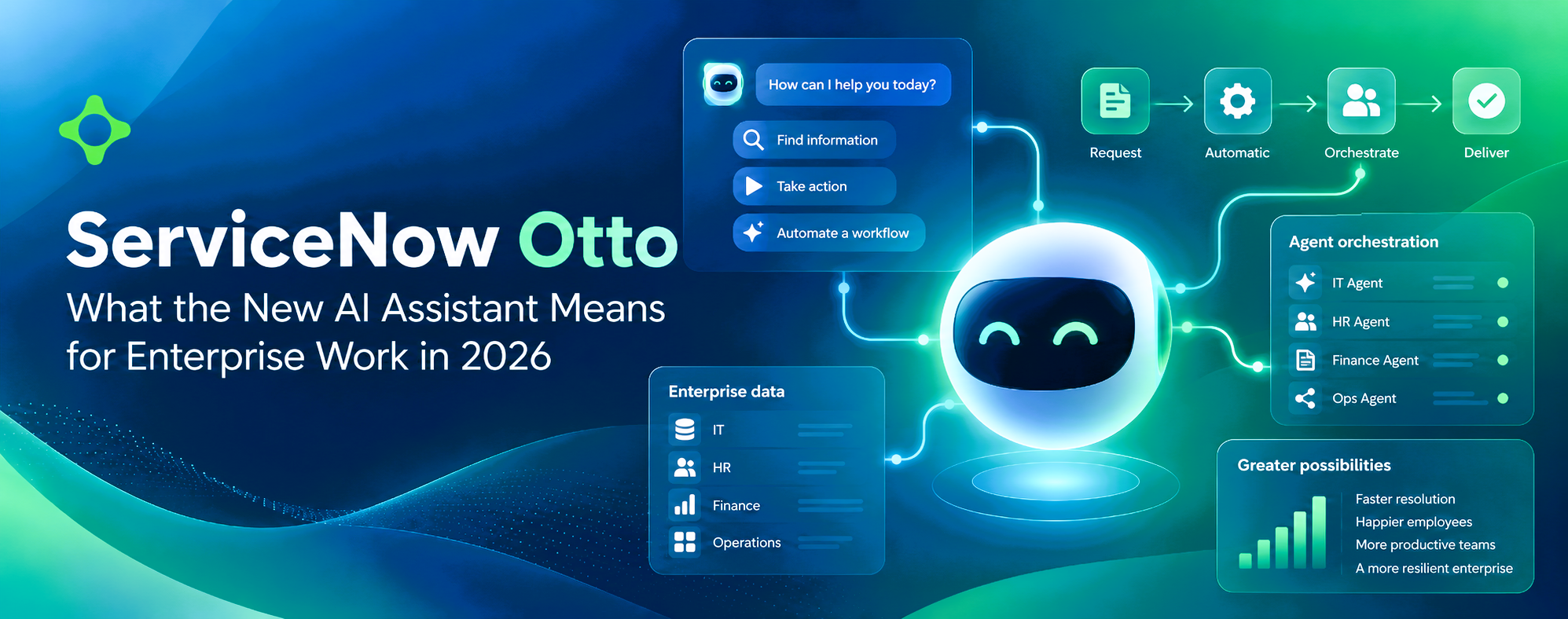
ServiceNow Otto Explained: What the New AI Assistant Means for Enterprise Work in 2026
Enterprise AI has become very good at answering questions. The bigger challenge is getting work completed.
An employee may ask an AI assistant how to request software access, troubleshoot a VPN issue, check an HR policy, or find the status of a customer case. The assistant may provide the right information, but the employee still often has to open another application, submit a form, wait for approval, contact another team, and track the request manually.
Blog Highlights
- ServiceNow Otto moves enterprise AI beyond Q&A by combining conversational AI, search, AI agents, and workflow execution in one experience.
- The real value is intent-to-completion: employees can describe what they need while ServiceNow coordinates the workflows, approvals, and systems behind the request.
- Otto is broader than Now Assist, bringing together capabilities from Now Assist, Moveworks, AI Experience, and ServiceNow AI agents.
- Enterprise use cases span ITSM, ITOM, HR, and customer service, with the potential to reduce manual handoffs and speed up resolution.
- Governance becomes critical once AI starts acting, making AI Control Tower and clearly defined autonomy levels increasingly important.
- Otto will not compensate for weak foundations. Clean data, optimized workflows, strong integrations, accurate knowledge, and clear permissions remain essential.
- The strategic shift is from systems of record to systems of action, where users express an outcome and AI coordinates the work required to achieve it.
- Enterprises should start with high-volume, predictable workflows and gradually move from AI assistance to controlled execution and higher levels of autonomy.
ServiceNow Otto is designed to change that experience.
Introduced in 2026, Otto brings together ServiceNow's conversational AI, enterprise search, AI agents, workflow automation, voice capabilities, and enterprise context into a more unified AI experience. The objective is not simply to answer an employee's question. It is to understand what the employee wants and help move the underlying work toward completion.
For enterprises already using ServiceNow or planning to modernize their service management environment, Otto represents a potentially important shift from AI assistance to AI-driven workflow execution.
What Is ServiceNow Otto?
ServiceNow Otto is the company's new enterprise AI experience that brings capabilities from Now Assist, Moveworks, AI Experience, AI agents, enterprise search, and workflow automation into a more unified interface.
Employees can interact through natural language rather than having to understand which ServiceNow module, form, workflow, or portal they need to use.
For example, instead of navigating through an IT service catalogue, an employee might simply say:
"I need Salesforce access for the new member joining my sales team next Monday."
The real value is not the conversational interface itself. The opportunity lies in what can happen after the request is understood.
Otto can potentially identify the user and organizational context, determine the appropriate workflow, initiate approval processes, involve AI agents, connect with enterprise systems, and provide updates as the request moves forward.
This makes Otto more than a traditional chatbot.
Otto, Now Assist, and AI Agents Are Not the Same Thing
It is useful to separate the different components of ServiceNow's AI strategy.
Now Assist introduced generative AI capabilities into ServiceNow workflows, helping users summarize incidents, generate content, search knowledge, and improve agent productivity.
AI agents are designed to perform more specialized tasks and participate in agentic workflows.
Otto acts more like the experience and orchestration layer through which users can express intent and interact with those capabilities.
At the same time, organizations should not assume every mention of Otto represents an entirely new capability. Some existing ServiceNow experiences are also being rebranded under the Otto name. Enterprises should therefore evaluate specific capabilities, licensing, integrations, and release availability rather than treating Otto as a single feature that can simply be switched on.
Why ServiceNow Otto Matters for Enterprise Work
The enterprise technology environment has become increasingly fragmented.
Employees may use ServiceNow for IT requests, Microsoft applications for productivity, Salesforce for CRM, Workday for HR, cloud platforms for infrastructure, and numerous specialized business applications.
The problem is that business processes rarely stay inside one system.
Consider employee onboarding.
Bringing a new employee into an organization may involve:
- HR records
- identity and access management
- device provisioning
- software access
- payroll
- security policies
- facilities
- manager approvals
An AI assistant that simply explains the onboarding process does not eliminate much operational work.
An AI experience capable of coordinating the underlying workflows potentially can.
This is where the ServiceNow Otto proposition becomes strategically relevant.
From Answering Questions to Completing Work
The easiest way to understand Otto is through the difference between information and action.
A conventional AI assistant may respond:
"You can request application access through the IT service portal."
An agentic workflow could potentially go further:
"I identified the access you require, created the request, sent it to your manager for approval, and will continue provisioning once approval is received."
That represents a significant shift.
The enterprise AI journey begins to move from:
Question → Answer
to:
Intent → Context → Workflow → Action → Outcome
For organizations using the ServiceNow platform, this means the focus of AI adoption may increasingly move beyond employee productivity and toward redesigning how operational work itself is performed.
How ServiceNow Otto Could Work Across Enterprise Functions
The potential value becomes clearer when applied to common business processes.
IT Service Management
An employee reports:
"My VPN stopped working after yesterday's update."
Instead of simply creating another ticket, an AI-driven process could potentially retrieve device context, review known issues, search relevant knowledge, perform diagnostic actions, recommend remediation, and escalate the incident only when human intervention is necessary.
The business objective therefore changes from faster ticket creation to faster issue resolution.
IT Operations
IT operations teams manage thousands of alerts, incidents, dependencies, and infrastructure events.
Combined with ServiceNow ITOM, AIOps, and AI agents, Otto could provide a simpler interface for investigating operational problems.
A user might ask:
"Why has checkout latency increased?"
The system could correlate operational context, identify related incidents, examine infrastructure signals, and initiate an appropriate workflow.
The goal becomes reducing the distance between a signal and an operational response.
HR Service Delivery
Employees frequently need assistance with onboarding, leave policies, benefits, payroll changes, workplace moves, or employment documentation.
Rather than navigating HR portals and forms, an employee could describe the desired outcome.
For example:
"I'm transferring to our London office next month. What needs to change?"
The value comes from connecting the conversation to actual HR processes, approvals, documentation, and downstream systems.
Customer Service
A customer does not necessarily want another support interaction. They want their problem resolved.
Consider:
"My replacement order has not arrived. Please send it to my office instead."
A useful AI experience needs more than conversational intelligence. It may require customer verification, order information, entitlement checks, shipping integration, approval rules, and communication workflows.
That combination of conversation and enterprise execution is where ServiceNow's broader agentic AI strategy becomes interesting.
ServiceNow Otto and the Rise of the System of Action
Enterprise applications have historically been designed as systems of record.
CRM stores customer information. HR systems store employee information. ITSM platforms store incidents and service requests.
Generative AI introduced another layer: systems that could interpret information and provide recommendations.
Agentic AI is pushing enterprise platforms toward something different: a system of action.
Instead of employees learning which application to open, which form to complete, and which workflow to follow, the user expresses the desired outcome.
The AI layer determines which systems, workflows, agents, approvals, and data are required.
The interface to enterprise software could therefore gradually move from:
Application → Menu → Form → Workflow
toward:
Intent → AI → Workflow → Outcome
That is the larger strategic story behind ServiceNow Otto.
Governance Will Become Critical as AI Starts Taking Action
There is an important difference between an AI system that recommends something and an AI system that executes something.
If an AI assistant provides an inaccurate answer, the organization has one type of risk.
If an AI agent changes permissions, modifies infrastructure, approves a transaction, updates customer records, or initiates procurement, the governance requirements are much higher.
This is why ServiceNow's broader AI strategy also includes AI Control Tower and governance capabilities.
Enterprises will need to establish clear boundaries around when AI can:
- provide recommendations
- prepare actions for approval
- execute predefined tasks
- operate autonomously
- escalate to a human
Successful enterprise AI adoption will therefore depend as much on governance and workflow design as it does on model capability.
Otto Will Not Fix Broken ServiceNow Processes
Enterprises should also avoid treating Otto as a shortcut around existing technology debt.
Agentic AI depends heavily on the quality of the underlying environment.
Poor data remains poor data.
An inefficient workflow does not become a good workflow simply because AI executes it faster.
Weak integrations will still limit cross-system automation.
Outdated knowledge will still generate poor outcomes.
Over-customized ServiceNow instances may make automation more difficult to scale.
Organizations still running older ITSM platforms should also consider whether their underlying service-management architecture is ready for this shift. For enterprises evaluating modernization, our Cherwell End of Life 2026: Complete Migration Guide to ServiceNow explains the migration considerations involved in moving toward a more modern ServiceNow environment.
Is Your ServiceNow Environment Ready for Otto?
This is where working with an experienced ServiceNow Partner can help enterprises assess workflow maturity, integration gaps, data readiness, and AI governance before introducing agentic capabilities.
Workflow Readiness
Which workflows are standardized, predictable, high-volume, and suitable for automation?
Data Readiness
Does ServiceNow have accurate and reliable data to provide the context AI agents require?
Integration Readiness
Can ServiceNow securely initiate actions across CRM, ERP, identity, cloud, HR, and other enterprise platforms?
Knowledge Readiness
Is enterprise knowledge accurate, structured, current, and appropriately permissioned?
Governance Readiness
Does the organization know what AI should be permitted to recommend, approve, or execute?
These questions are more important than simply asking whether Otto is available.
Where Should Enterprises Start?
The best starting point is unlikely to be enterprise-wide autonomous AI.
Organizations should first identify high-volume, repetitive, well-understood workflows where the business value and risk can be clearly measured.
Examples may include:
- password and access requests
- knowledge retrieval
- incident summarization
- common service requests
- employee policy queries
- basic troubleshooting
- onboarding activities
The workflow should then be optimized before AI is introduced.
Enterprises can gradually progress from AI assistance to recommendations, controlled execution, and eventually higher levels of autonomy where the business case and governance model support it.
What ServiceNow Otto Means for Enterprise Leaders
ServiceNow Otto signals a broader change in the way enterprise AI is evolving.
The first generation of enterprise generative AI focused heavily on helping people create, search, summarize, and answer questions.
The next stage is about getting work done.
That does not mean removing people from every workflow. It means determining where AI agents, automation, enterprise data, and human decision-making should work together.
For ServiceNow customers, the strategic question is therefore no longer simply:
"How can employees use an AI assistant?"
A more important question is:
Which parts of enterprise work are we ready to let AI complete?
Organizations that answer that question carefully and build the workflows, integrations, governance, and data foundations required to support it will be better positioned to capture meaningful value from ServiceNow's move toward agentic AI.
 Few
More from
Administrator
Few
More from
Administrator
Category: ServiceNow
Recent Posts
-
Salesforce
Aress showcases Salesforce delivery strength as Explorer Sponsor at Salesforce World Tour Essentials Sydney
-
Digital
From Vulnerability Management to Threat Detection: Building a Continuous VAPT Program for the Enterprise
-
Digital
AI vs AI: How Enterprises Can Defend Against the New Generation of AI-Powered Cyberattacks
-
Digital
Cybersecurity Awareness Month 2026: How to Benchmark Your Enterprise Security Posture
-
Digital
Cybersecurity Awareness Month 2026: What Should Be on Every Enterprise Security Checklist?