 +91 253 6630710
 781.258.1274
 +44 (0) 7446 87 37 97
5 Salesforce Fixes To Improve MedTech Sales Performance


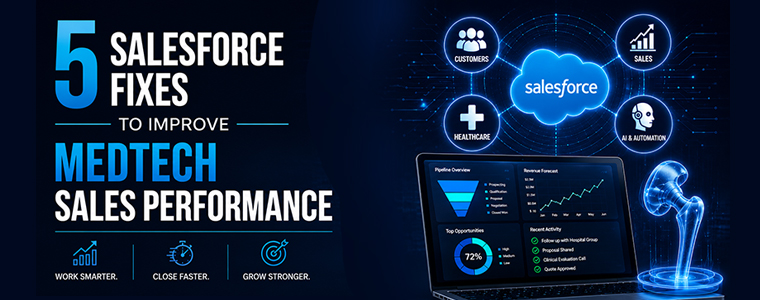
5 Salesforce Fixes To Improve MedTech Sales Performance
The MedTech industry is evolving rapidly. Sales teams today are expected to manage longer buying cycles, complex distributor networks, compliance-heavy workflows, and rising customer expectations, all while maintaining visibility across fragmented systems.
Many MedTech companies already use Salesforce, but very few are using it to its full potential.
Disconnected data, manual workflows, poor pipeline visibility, and limited integrations often prevent sales teams from scaling efficiently. As AI and automation become more important, these CRM inefficiencies can directly impact revenue growth.
The good news? Strategic Salesforce optimization can significantly improve sales efficiency, forecasting accuracy, customer engagement, and operational scalability.
In this blog, we explore five critical Salesforce fixes that can help MedTech organizations improve sales performance and prepare for AI-driven growth.
Blog Highlights
- Why disconnected CRM systems slow down MedTech sales teams
- How Salesforce automation improves sales efficiency
- The importance of ERP and healthcare system integrations
- How better pipeline visibility improves forecasting accuracy
- Why AI-ready Salesforce architecture matters for MedTech growth
Fix #1: Eliminate Disconnected Customer and Distributor Data
One of the biggest challenges in MedTech sales is fragmented customer information spread across:
- ERP systems
- Distributor platforms
- Marketing tools
- Customer support systems
- Legacy databases
This creates incomplete account visibility and slows down decision-making for sales teams.
Without a unified customer view, sales representatives often struggle with:
- Duplicate records
- Outdated account data
- Inconsistent communication
- Poor forecasting accuracy
- Delayed follow-ups
Modern MedTech organizations need Salesforce to function as a centralized intelligence platform and not just a CRM.
By implementing strong Salesforce Integration Services, businesses can connect Salesforce with ERP, finance, support, and healthcare systems to create a unified customer ecosystem.
Using tools like MuleSoft, APIs, and scalable middleware frameworks, MedTech organizations can:
- Improve account visibility
- Reduce manual entry
- Streamline distributor collaboration
- Enable real-time reporting
- Enhance customer experiences
A connected Salesforce environment creates a stronger foundation for AI, automation, and long-term scalability.
Fix #2: Automate Manual Sales Processes
Many MedTech sales teams still rely heavily on manual workflows for:
- Lead assignments
- Quote approvals
- Follow-ups
- Onboarding
- Renewals
- Territory management
These repetitive tasks reduce productivity and increase the risk of delays or human errors.
Salesforce automation can significantly improve operational efficiency by streamlining routine processes and reducing administrative burden.
With Salesforce Managed Services, businesses can optimize:
- Approval workflows
- Lead routing
- Opportunity tracking
- Account management
- Customer communication
Modern Salesforce automation tools such as Flow and Agentforce also help MedTech organizations automate complex workflows across sales and customer service operations.
The result:
- Faster response times
- Improved sales productivity
- Better CRM adoption
- Reduced operational overhead
Automation allows MedTech sales teams to focus more on building relationships and closing deals instead of managing repetitive CRM tasks.
Fix #3: Improve Pipeline Visibility Across Long Sales Cycles
MedTech sales cycles are often lengthy and involve multiple stakeholders, including:
- Procurement teams
- Healthcare providers
- Compliance officers
- Distributors
- Finance departments
Without proper CRM visibility, it becomes difficult to accurately forecast revenue or identify pipeline risks.
Common Salesforce issues in MedTech include:
- Inconsistent opportunity stages
- Missing customer activity data
- Outdated reports
- Lack of forecasting accuracy
- Poor sales accountability
Improving Salesforce pipeline management helps leadership teams gain real-time insights into:
- Deal progress
- Stalled opportunities
- Account engagement
- Territory performance
- Sales forecasting
AI-driven Salesforce dashboards and automation tools can also provide predictive insights that help sales teams prioritize high-value opportunities.
A properly optimized Salesforce environment enables MedTech organizations to:
- Shorten sales cycles
- Improve forecasting accuracy
- Increase pipeline transparency
- Enhance sales collaboration
- Drive better revenue outcomes
Fix #4: Integrate Salesforce with ERP, Marketing, and Support Systems
Salesforce becomes significantly more powerful when connected with the broader business ecosystem.
Many MedTech organizations operate with disconnected systems for:
- ERP
- Finance
- Marketing automation
- Customer support
- Inventory management
- Field service operations
This lack of integration creates operational silos that impact customer experiences and slow down decision-making.
Implementing Salesforce integration services helps unify business operations and enables seamless data flow across systems.
Integrations using MuleSoft, APIs, and middleware platforms can help organizations:
- Synchronize customer data
- Automate workflows
- Improve inventory visibility
- Streamline order management
- Improve service coordination
For MedTech businesses managing complex customer journeys, connected systems improve both operational efficiency and customer satisfaction.
Integrated Salesforce ecosystems also support future AI initiatives by providing clean, centralized, and real-time business data.
Fix #5: Prepare Your Salesforce Org for AI and Agentforce
AI is rapidly transforming how MedTech organizations engage customers, automate workflows, and improve operational efficiency.
However, AI success depends heavily on CRM readiness.
Many Salesforce environments are not fully prepared for AI adoption due to:
- Fragmented customer data
- Outdated workflows
- Poor integrations
- Low CRM adoption
- Inconsistent governance
This is where Salesforce Agentforce services can help.
Agentforce introduces autonomous AI agents capable of:
- Automating repetitive workflows
- Supporting customer interactions
- Assisting sales teams with insights
- Improving service response times
- Streamlining operations
Combined with Salesforce Data Cloud and intelligent automation, Agentforce enables MedTech organizations to build scalable AI-ready CRM environments.
An AI-ready Salesforce ecosystem helps businesses:
- Improve customer engagement
- Accelerate decision-making
- Reduce operational inefficiencies
- Scale automation securely
- Support future digital transformation initiatives
Organizations that optimize Salesforce today will be significantly better positioned to leverage AI-driven growth opportunities tomorrow. As AI adoption accelerates, many organizations are also moving toward headless Salesforce architectures, where AI agents, applications, and digital platforms interact directly with Salesforce through APIs and automation layers instead of traditional CRM interfaces.
Conclusion
For MedTech organizations, Salesforce is no longer just a CRM platform, it is becoming the operational foundation for sales performance, automation, customer engagement, and AI transformation.
By addressing key issues such as:
- Disconnected data
- Manual processes
- Limited pipeline visibility
- Poor integrations
- AI readiness gaps
businesses can significantly improve sales efficiency and operational scalability.
A well-optimized Salesforce environment helps MedTech sales teams work smarter, improve forecasting accuracy, automate workflows, and prepare for the future of AI-driven healthcare engagement.
FAQs
What are common Salesforce challenges for MedTech companies?
Common challenges include disconnected systems, poor CRM adoption, manual workflows, limited pipeline visibility, and lack of integration between Salesforce and ERP or healthcare platforms.
How can Salesforce improve MedTech sales performance?
Salesforce helps MedTech organizations improve sales visibility, automate workflows, streamline customer engagement, and enhance forecasting accuracy through connected CRM operations.
Why are Salesforce integrations important for MedTech businesses?
Integrations help unify customer, distributor, finance, and operational data across systems, improving efficiency and enabling real-time business visibility.
What is Salesforce Agentforce?
Salesforce Agentforce is an AI-powered platform that enables organizations to deploy autonomous AI agents for sales, service, and workflow automation.
How can AI improve MedTech CRM operations?
AI can automate repetitive tasks, improve forecasting, assist sales teams with insights, streamline customer service, and enhance operational efficiency across healthcare organizations.
 Few
More from
Administrator
Few
More from
Administrator
Category: Salesforce
Recent Posts
-
Digital
AI vs AI: How Enterprises Can Defend Against the New Generation of AI-Powered Cyberattacks
-
Digital
Cybersecurity Awareness Month 2026: How to Benchmark Your Enterprise Security Posture
-
Digital
Cybersecurity Awareness Month 2026: What Should Be on Every Enterprise Security Checklist?
-
ServiceNow
ServiceNow Otto Explained: What the New AI Assistant Means for Enterprise Work in 2026
-
Digital
Small Business Website Security: How to Protect Your Site and Customer Data