 +91 253 6630710
 781.258.1274
 +44 (0) 7446 87 37 97
 +61 401 202 656
Fewer Platforms, Faster AI: The Business Case for Consolidating a Fragmented Data Estate on Databricks



Fewer Platforms, Faster AI: The Business Case for Consolidating a Fragmented Data Estate on Databricks
Why the cost of platform sprawl rarely shows up where you expect it, how a Lakehouse architecture changes the economics of data and AI, and how to prove the business case with your own numbers.
The conversation tends to go the same way. The executive team approves an AI initiative, an assistant for the service desk, perhaps, or better demand forecasting, and asks the data team when it can go live. The honest answer is rarely about the model. It is about the data: customer records split across a warehouse, a data lake and two SaaS applications; three competing definitions of an “active customer”; and an access-approval process that takes longer than the pilot itself.
Few organizations designed their data estate this way. It accumulated. A warehouse was bought for finance reporting. A data lake arrived when clickstream or sensor volumes outgrew it. A separate machine learning environment appeared when the first data scientists were hired, and, more recently, a vector database and an LLM gateway were added for generative AI experiments. Each decision was sensible at the time. Together, they produce an estate in which the same data is copied, transformed and secured several times over, by different teams, on different platforms, under different rules.
The cost is easy to underestimate because it is spread across budgets. Some of it is visible on the cloud bill. Far more sits in engineering time spent moving data between systems, reconciling numbers that ought to match and maintaining access controls in several places at once. And as organizations try to scale AI, fragmentation stops being an inefficiency and becomes the main obstacle.
Where fragmentation actually costs money
“Platform sprawl” can sound like an abstract complaint, so it is worth being precise about where the cost sits.
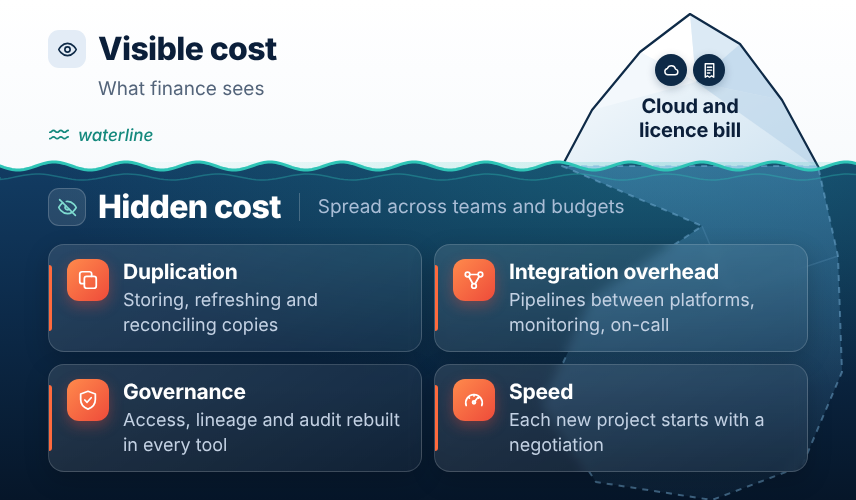
Figure 1. Most of the cost of a fragmented estate sits below the waterline.
The first cost is duplication. When the warehouse, the lake and the ML environment each hold their own copy of core datasets, the organisation pays to store, process and refresh every copy. More importantly, it pays to keep them consistent, and frequently fails. Finance and operations arrive at the same meeting with different revenue figures, and confidence in the data takes another knock.
The second is integration overhead. Every hop between platforms needs a pipeline, and every pipeline needs monitoring, error handling and someone to fix it when it breaks overnight. In fragmented estates, a large share of data engineering capacity goes on keeping data moving rather than making it more useful.
The third is governance. When permissions, lineage and auditing are defined separately in each tool, simple questions become hard to answer with confidence. Who can see this customer’s data? Where did this board-pack figure come from? Which model was trained on which version of which table? For financial services, healthcare and public-sector organizations, these are regulatory questions, not academic ones.
The fourth is speed. Almost every new analytics or AI use case needs data from several sources. When that data lives on platforms with different security models, each project starts with a negotiation rather than a query.
Why the traditional model is getting harder to sustain
None of this is an argument against data warehouses, or against any particular vendor. Warehouses remain very good at what they were designed for: governed, high-performance SQL over structured data. What has changed is the mix of work the data estate is expected to support.
Today’s enterprise needs BI dashboards, near-real-time operational data, data science over semi-structured and unstructured data, and generative AI applications that retrieve documents and call business systems, frequently over the same customers, products and transactions. The traditional answer is a specialized system for each workload, joined by pipelines. That works at modest scale. As workloads multiply, so do integration points, copies and security policies, and the operating model becomes harder to staff and harder to explain to the CFO.
AI sharpens the problem considerably. A retrieval-augmented assistant is only as reliable as the documents and tables behind it. An agent that can take actions needs exactly the same access controls as the person it is acting for. An organisation that cannot govern data consistently across its platforms will find it very difficult to govern the AI built on top of them.
The Lakehouse as an architectural response
The Databricks Data Intelligence Platform starts from a different premise. Rather than moving data to each workload, it keeps data in open formats in the organization’s own cloud storage and brings the workloads to the data: data engineering, SQL analytics, BI, machine learning and generative AI. This is the Lakehouse pattern, the economics and flexibility of a data lake combined with the reliability, performance and governance traditionally expected of a warehouse.
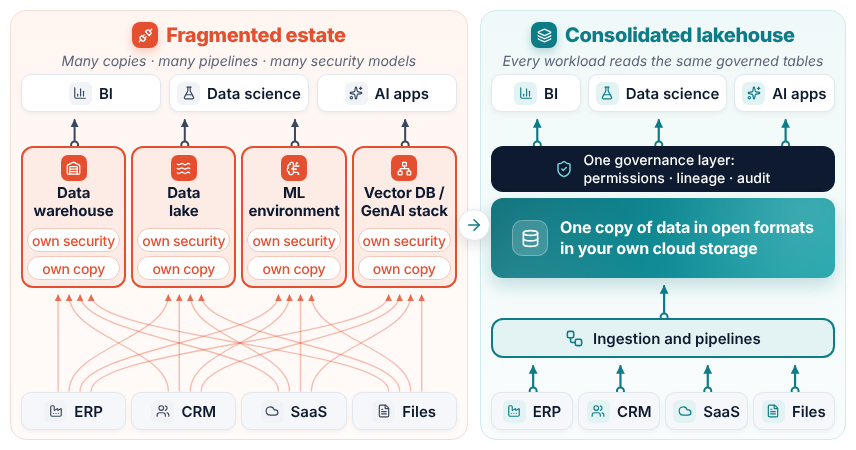
Figure 2. From many copies and security models to one governed copy serving every workload.
Three architectural choices give this commercial weight.
First, data lives in open table formats. Delta Lake is the default, and Databricks also supports Apache Iceberg, so tables are not tied to a single proprietary engine. The same governed table can serve a SQL analyst, a data scientist and an AI application without being copied for each.
Second, governance sits in one layer. Unity Catalog provides one place to manage permissions, lineage and auditing across tables, files, machine learning models and AI assets. A policy defined once applies wherever the data is used.
Third, the platform uses AI on its own metadata and usage patterns, what Databricks describes as “data intelligence”. In practice, this shows up as automated table optimisation, AI-suggested documentation and natural-language querying. None of it removes the need for good data design, but it does reduce the amount of manual tuning and tribal knowledge a platform depends on.
Consolidation also does not have to be a big-bang exercise. Lakehouse Federation allows external databases to be queried under Unity Catalog governance while migration proceeds in phases, and Delta Sharing lets organizations share live data with partners and suppliers without creating yet another copy.
The capabilities that matter for consolidation
A platform consolidation is judged on whether it removes work and risk, not on how many features it adds. Viewed that way, a handful of capabilities carry most of the argument.
Unity Catalog for unified governance. Technically, it is a single catalogue with fine-grained access control, automated lineage and audit logging across data and AI assets. The problem it solves is the multiplication of security models across tools. The business impact is faster, safer access: a data product can be opened to a new team or an AI application through one governed policy rather than a ticket chain across several systems.
Lakeflow for data engineering. Lakeflow brings together ingestion (Lakeflow Connect), declarative pipeline development (Lakeflow Declarative Pipelines) and orchestration (Lakeflow Jobs). Declarative pipelines let engineers describe the tables they want and the data-quality expectations those tables must meet, while the platform manages dependencies, retries and incremental processing. Fewer hand-built pipelines between platforms means fewer failure points, and engineers spending more time on new data products than on keeping old ones alive.
Databricks SQL and AI/BI for analytics. Databricks SQL provides serverless SQL warehousing directly on lakehouse tables, so BI no longer requires a separate copy of the data. AI/BI adds dashboards and Genie, a natural-language interface that lets business users ask questions of governed data. For organizations standardized on Microsoft, Power BI connects to Databricks natively, so consolidation does not require replacing the reporting tools people already use. The payoff is one version of the figures, served to whichever front end the business prefers.
MLflow and Mosaic AI for machine learning and generative AI. Managed MLflow covers experiment tracking, model registry, evaluation and tracing, while Mosaic AI provides model serving, vector search and tooling for building and evaluating AI agents. The key point for a consolidation case is that models and AI applications are trained on, and retrieve from, the same governed tables the business already reports on. AI no longer needs its own shadow data estate.
Serverless compute and system tables for cost control. Serverless options reduce the effort of sizing and managing clusters, and system tables expose billing and usage data that can be queried like any other dataset. That gives FinOps teams cost per workload, per team or per data product, the visibility needed to prove a TCO case rather than simply assert it.
A practical reference architecture
A consolidated estate typically settles into a small number of layers, with governance running through all of them.
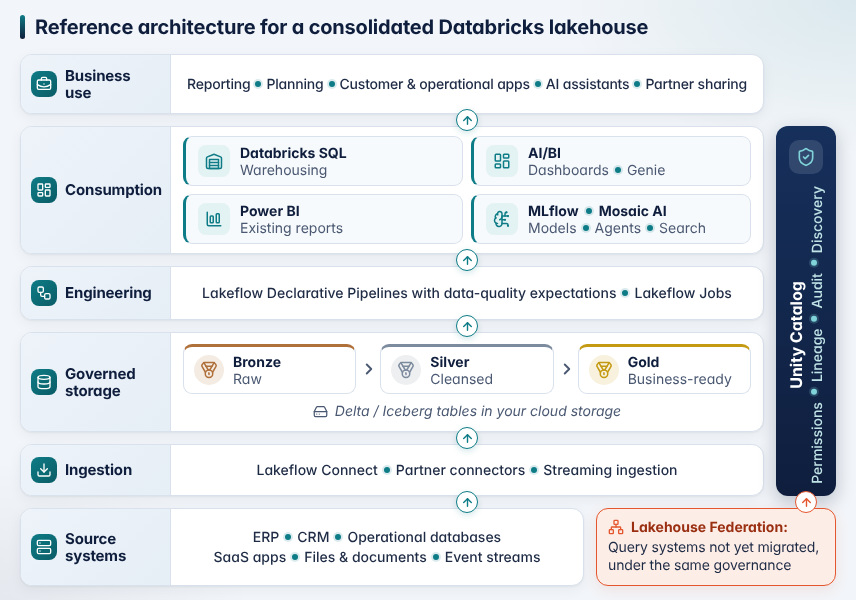
Figure 3. Reference architecture for a consolidated Databricks lakehouse.
Two things are worth drawing out. Unity Catalog is not a separate box at one level; it spans every layer from ingestion to consumption, which is precisely why governance becomes cheaper rather than more expensive as the platform grows. And the “gold” layer is where most of the business value is decided. Well-modelled, documented, business-ready tables are what make self-service BI, Genie and AI agents trustworthy. Skimp on them and every downstream tool inherits the confusion.
Measuring the business value honestly
It is tempting to lead a business case with a headline savings figure. Published benchmarks and vendor studies can be useful context, but the only numbers that will survive scrutiny from a CFO are the organization’s own. Organizations should establish baseline metrics before implementation and measure the same indicators at defined points afterwards. The KPIs that matter most in a consolidation programme are set out below.
| KPI | What it tells you |
|---|---|
| Total cost of ownership over three years | Platform, licence, infrastructure and support costs, including the platforms you retire |
| Cost per workload or data product | Whether consolidation is reducing unit cost, not just moving spend |
| Number of duplicated datasets | How much copy-and-reconcile effort has genuinely gone |
| Pipeline development time | How long it takes to deliver a new data feed into production |
| Pipeline failure rate and support hours | The operational burden on engineering and support teams |
| Data freshness | How current the data is when the business uses it |
| Query performance on priority reports | Whether analysts and business users feel the difference |
| Time to access approval | How long a team waits to use data it is entitled to |
| Time to deploy an ML model or AI application | Whether the platform is actually accelerating AI |
Two cautions. Measure the platforms you switch off as rigorously as the one you switch on. And separate one-off migration costs from run costs, or the first year will distort the picture in both directions.
What makes consolidation succeed
Technology is the easier half of this. The programmes that disappoint usually do so for organizational reasons.
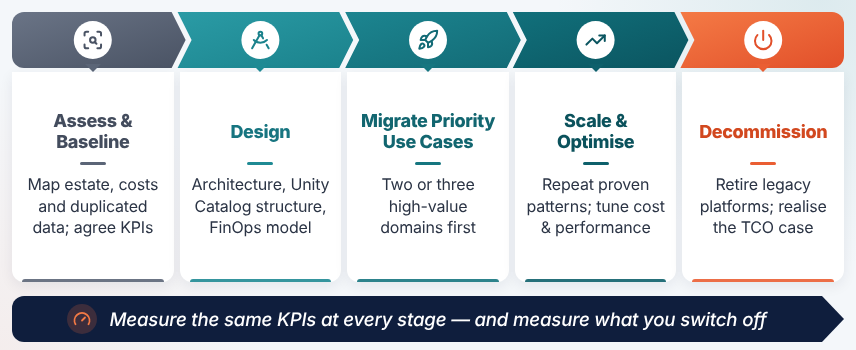
Figure 4. A phased consolidation path, with measurement running throughout.
Start from use cases, not inventory. Migrating everything “because we’re consolidating” is slow and hard to justify. A better approach is to identify two or three high-value use cases, often a reporting domain with known reconciliation problems and one AI use case blocked by data access, and design the target platform around them. Later domains then follow a proven pattern.
Decide between modernizing and lifting-and-shifting, deliberately. Moving legacy warehouse logic across unchanged is quicker, but it carries old technical debt into a new platform. Rebuilding everything is cleaner but slower. Most estates need both, domain by domain, and the decision should be recorded rather than left to whichever engineer picks up the ticket.
Design governance before data arrives. Catalogue structure, ownership, naming, access patterns and data classification are far cheaper to set up at the start than to retrofit. This is also where AI governance begins: if agents and models are registered and permissioned in Unity Catalog from day one, auditability comes almost for free.
Treat data quality as an engineering discipline. Quality expectations belong in the pipelines, with clear owners and visible failure handling, not in a spreadsheet maintained by one analyst.
Build FinOps in from the first workload. Tagging, compute policies, budget alerts and regular review of system-table data stop consumption-based pricing from becoming a surprise. A flexible platform makes it easy to spend money quickly; a cost model with owners makes it predictable.
Automate delivery. Version-controlled code, CI/CD (for example, using Databricks Asset Bundles) and separate development, test and production environments matter as much for data and AI as for application software. For ML and generative AI, that extends to evaluation, monitoring and rollback.
Plan the decommissioning. This is the step most often skipped, and it is where the TCO case is won or lost. If the old warehouse, lake and ML environment are still running two years later, the organisation has added a platform, not consolidated onto one. Retirement dates belong in the plan from the outset.
Invest in adoption. A new platform changes how analysts, engineers and data scientists work. Training, documented patterns and a clear operating model, who owns which data products, who approves access, who supports what, determine whether the investment is used.
How Aress can help
As a Databricks Consulting and System Integrator Partner, Aress helps organizations assess, design, implement and optimize data and AI solutions built on the Databricks Data Intelligence Platform.
For most organizations, the right starting point is a readiness assessment. That means mapping the current estate, its costs and its duplicated data, then identifying the use cases where consolidation would deliver value soonest and agreeing the baseline metrics against which progress will be measured. From there, Aress can support lakehouse architecture and platform strategy, Unity Catalog and governance design, data engineering with Lakeflow, and the phased migration of existing warehouses and data lakes.
Because many estates are built around Microsoft technologies, Aress also helps integrate Databricks with Power BI and the wider Microsoft ecosystem, so business users keep familiar tools while the data beneath them is consolidated. As platforms mature, the work extends into machine learning and generative AI solutions, performance tuning, FinOps and cost optimisation, and ongoing production support, the continuous improvement that keeps a consolidated platform delivering value after go-live.
The real prize
Consolidating a data estate is sometimes presented as an infrastructure tidy-up. It is more consequential than that. Done well, it lowers the cost of every future analytics and AI initiative, because each one starts from governed, trusted, accessible data instead of a negotiation between platforms. Done poorly, it becomes another platform to maintain.
The difference lies in starting from business outcomes, measuring honestly and retiring what is replaced. For organizations weighing where Databricks could fit into their data and AI modernization, a structured assessment of the current estate is a sensible first step, and a conversation Aress would be glad to have.

 Few
More from
Kiran Vidhate
Category: GenAI & Data Engineering
Recent Posts
-
GenAI & Data Engineering
Fewer Platforms, Faster AI: The Business Case for Consolidating a Fragmented Data Estate on Databricks
-
Salesforce
Aress showcases Salesforce delivery strength as Explorer Sponsor at Salesforce World Tour Essentials Sydney
-
Digital
From Vulnerability Management to Threat Detection: Building a Continuous VAPT Program for the Enterprise
-
Digital
AI vs AI: How Enterprises Can Defend Against the New Generation of AI-Powered Cyberattacks
-
Digital
Cybersecurity Awareness Month 2026: How to Benchmark Your Enterprise Security Posture