 +91 253 6630710
 781.258.1274
 +44 (0) 7446 87 37 97
How to Add LLM Features to an Enterprise Mobile App Without Rebuilding It


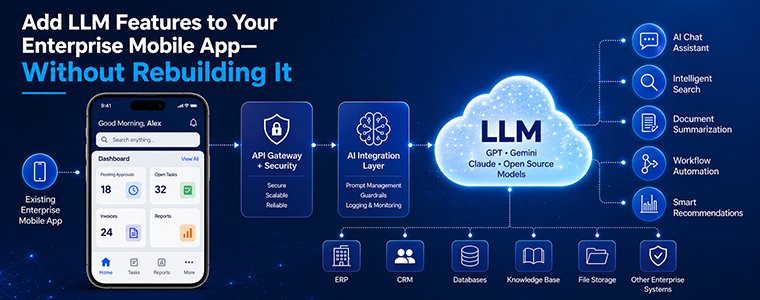
How to Add LLM Features to an Enterprise Mobile App Without Rebuilding It
Enterprise mobile applications are no longer expected to simply perform transactions, they're expected to understand context, generate content, summarize information, automate workflows, and assist users intelligently.
This shift has been driven by the rapid adoption of Large Language Models (LLMs) such as GPT, Gemini, Claude, and open-source alternatives.
However, one misconception prevents many enterprises from embracing AI:
"We need to rebuild our mobile app to add AI."
The reality is quite different.
In most cases, organizations can introduce LLM capabilities into their existing applications through a modular architecture without redesigning the entire application. Modern APIs, AI gateways, microservices, and enterprise integration layers make it possible to add intelligence while preserving the application's existing user experience and business logic. Incremental, API-first integration is now the dominant enterprise approach rather than full rewrites.
This article explains how enterprises can successfully modernize existing applications using LLMs-and why working with experienced mobile app development services providers dramatically reduces implementation risk.
Blog Highlights
In this article, you'll learn:
- Why you don't need to rebuild your enterprise mobile app to leverage Large Language Models (LLMs)
- The most valuable AI features you can add, from intelligent search to AI assistants and document summarization
- A secure, scalable architecture for integrating LLMs into existing mobile applications
- The best integration approaches, including API-based integration, AI microservices, and Retrieval-Augmented Generation (RAG)
- Essential security, governance, and performance best practices for enterprise AI
- Common pitfalls to avoid when modernizing enterprise mobile apps with Generative AI
- How Aress helps businesses seamlessly integrate AI into existing mobile applications without costly redevelopment
Why Rebuilding Your Mobile App Is Usually Unnecessary
A mature enterprise application already contains valuable assets:
- Stable business workflows
- Authentication systems
- User roles and permissions
- Backend APIs
- Enterprise databases
- ERP/CRM integrations
- Mobile UI already familiar to employees
LLMs do not replace these systems.
Instead, they become an intelligent layer that enhances them.
Think of an LLM as another backend service.
Rather than rebuilding screens, organizations simply connect selected workflows to an AI service that returns intelligent responses.
This approach reduces:
- Development cost
- Migration risks
- User retraining
- Downtime
- Time-to-market
Enterprise Use Cases That Can Be Added Without Rebuilding
Instead of adding AI everywhere, successful organizations identify high-value, repetitive workflows where language understanding creates measurable productivity improvements.
Some examples include:
Intelligent Voice Search
Employees no longer search using exact keywords.
They ask:
- "Show my pending approvals."
- "Find invoices from last quarter."
- "Which customers haven't renewed?"
The LLM converts natural language into structured system queries.
AI Assistants
Enterprise apps can include assistants that help users:
- Navigate workflows
- Explain reports
- Answer policy questions
- Guide onboarding
- Troubleshoot issues
Document Summarization
Instead of reading:
- PDFs
- Contracts
- Audit reports
- Meeting notes
Users receive concise summaries generated by the LLM.
Content Generation
Enterprise teams can generate:
- Emails
- Inspection reports
- CRM notes
- Sales proposals
- Customer responses
within seconds.
Smart Form Filling
The AI extracts information from uploaded files and automatically fills application forms, significantly reducing manual effort.
Workflow Automation
LLMs can orchestrate multi-step processes such as:
- Creating tickets
- Drafting approvals
- Routing documents
- Triggering notifications
- Updating CRM records
A Modern LLM Architecture for Enterprise Mobile Apps
A common misconception is that the mobile application communicates directly with the AI model.
In enterprise environments, this is almost never recommended.
Instead, the architecture typically looks like this:
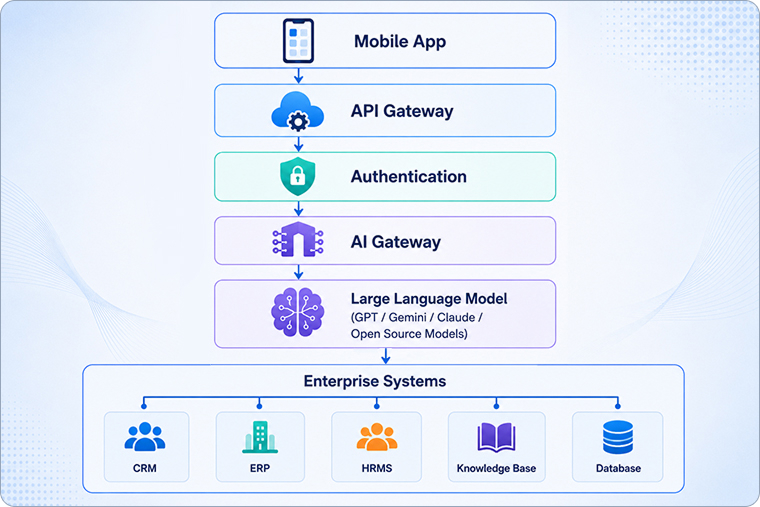
This architecture offers several advantages:
- API keys never reside on the mobile device
- Business rules remain centralized
- Prompt versions can be managed independently
- AI providers can be changed without updating the mobile app
- Logging, monitoring, and rate limiting become easier
Best Integration Approaches
1API-Based Integration
The fastest approach.
The mobile application sends requests to backend APIs that interact with the LLM.
Ideal for:
- Chat
- Summaries
- Search
- Recommendations
2AI Microservices
Instead of embedding AI logic into existing applications, enterprises build independent AI services.
Benefits include:
- Easier maintenance
- Independent scaling
- Technology flexibility
- Better monitoring
3Retrieval-Augmented Generation (RAG)
Most enterprise AI projects don't require fine-tuning.
Instead, RAG connects the LLM to internal knowledge bases, allowing responses to be grounded in current enterprise content while avoiding retraining.
Benefits:
- Current information
- Enterprise knowledge
- Better accuracy
- Faster deployment
- Lower costs
4Hybrid AI Architecture
Some tasks execute on-device.
Others execute in the cloud.
For example:
On Device
- Text classification
- Intent detection
- Simple suggestions
Cloud
- Complex reasoning
- Document analysis
- Enterprise search
- AI assistants
This balances speed, privacy, and operating costs.
Security Considerations
Security remains one of the biggest concerns when integrating LLMs into enterprise applications.
Organizations should ensure:
Data Encryption
Encrypt data in transit and at rest.
Role-Based Access Control
Only authorized users should access AI features.
Prompt Security
Prompt injection attacks should be mitigated through validation and guardrails.
Personally Identifiable Information (PII)
Sensitive customer information should be masked before being sent to external LLM providers.
Audit Logs
Every AI interaction should be traceable for compliance and governance.
Performance Best Practices
Enterprise users expect mobile apps to remain responsive.
To achieve this:
- Stream responses instead of waiting for completion
- Cache frequently requested information
- Limit token usage
- Use asynchronous processing
- Retry failed requests gracefully
- Optimize prompts for concise responses
Common Mistakes Enterprises Make
Trying to Add AI Everywhere
Not every workflow benefits from AI.
Start with high-value use cases.
Putting API Keys in Mobile Apps
Credentials should always remain on secure backend infrastructure.
Ignoring Governance
Without logging and monitoring, enterprises lose visibility into AI behavior.
Skipping Human Validation
AI-generated outputs should support human decision-making in critical business processes.
Choosing the Wrong Model
Different use cases require different models.
For example:
- Customer support
- Code generation
- Document summarization
- Knowledge retrieval
may each benefit from different LLMs.
Industries Benefiting from LLM-Powered Mobile Apps
Almost every industry can modernize existing mobile applications through AI.
Examples include:
Healthcare
- Clinical documentation
- Patient summaries
- Knowledge assistants
Manufacturing
- Maintenance guidance
- Equipment troubleshooting
- Inspection reporting
Financial Services
- Customer support
- Loan document analysis
- Fraud investigation assistance
Retail
- Product recommendations
- Inventory insights
- Store operations
Logistics
- Delivery optimization
- Driver assistance
- Route explanations
Why Choose Aress for Enterprise AI Mobile App Development?
Adding AI capabilities to an enterprise application requires far more than integrating an API. Success depends on designing secure architectures, protecting sensitive business data, and ensuring that AI enhances-not disrupts-existing workflows.
Aress helps organizations modernize mobile applications by combining deep expertise in enterprise mobility, cloud platforms, API integration, AI solutions, and secure software engineering.
Our team can help you:
- Assess your application's AI readiness
- Identify high-value LLM use cases
- Design secure AI architectures
- Integrate GPT, Gemini, Claude, or open-source models
- Implement RAG for enterprise knowledge
- Optimize performance and cost
- Ensure compliance and governance
Whether you need a new enterprise application or want to modernize an existing one, our Mobile App Development Services help you adopt AI without the risks and costs of a complete rebuild.
Frequently Asked Questions (FAQs)
Can I add AI to my existing enterprise mobile app?
Yes. Most enterprise applications can integrate LLM capabilities through APIs, AI services, or microservices without rebuilding the application from scratch.
Do I need to train my own language model?
Usually not. Most organizations achieve excellent results using foundation models combined with Retrieval-Augmented Generation (RAG) and enterprise data.
Is enterprise data safe when using LLMs?
Yes, provided the solution follows enterprise security best practices such as encryption, access control, data masking, audit logging, and secure backend integrations.
Which AI features provide the fastest ROI?
Organizations typically see strong returns from intelligent search, document summarization, AI assistants, workflow automation, and content generation.
How long does it take to integrate LLM features?
A focused proof of concept can often be delivered within weeks. Broader enterprise rollouts depend on application complexity, integrations, governance, and testing requirements.
 Few
More from
Administrator
Few
More from
Administrator
Category: Digital
Recent Posts
-
Digital
AI vs AI: How Enterprises Can Defend Against the New Generation of AI-Powered Cyberattacks
-
Digital
Cybersecurity Awareness Month 2026: How to Benchmark Your Enterprise Security Posture
-
Digital
Cybersecurity Awareness Month 2026: What Should Be on Every Enterprise Security Checklist?
-
ServiceNow
ServiceNow Otto Explained: What the New AI Assistant Means for Enterprise Work in 2026
-
Digital
Small Business Website Security: How to Protect Your Site and Customer Data