 +91 253 6630710
 781.258.1274
 +44 (0) 7446 87 37 97
AI vs AI: How Enterprises Can Defend Against the New Generation of AI-Powered Cyberattacks


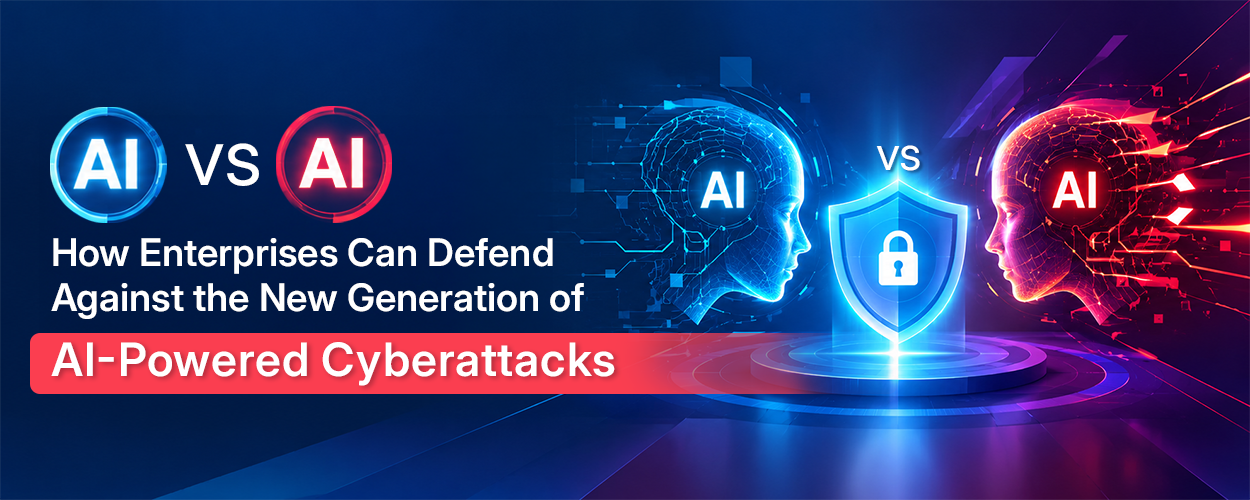

AI vs AI: How Enterprises Can Defend Against the New Generation of AI-Powered Cyberattacks
For most of cybersecurity's history, attackers and defenders operated at roughly comparable speeds. AI has broken that symmetry, and not in the defender's favor by default. Enterprises that treat AI purely as a productivity story for their own teams, while ignoring what it has done to the offensive side of the equation, are underestimating the shift underway in 2026.
Quick Answer:
AI has made cyberattacks faster, more convincing and easier to scale, particularly in phishing, malware generation and automated reconnaissance. Effective enterprise defense requires AI-assisted detection to match that speed, but AI defense alone is not sufficient. It needs to be paired with structured, human-led testing (VAPT) that validates whether defenses actually hold against real exploitation attempts, since automated systems on both sides can miss context that experienced testers catch.
How AI Has Changed the Offensive Side
Convincing Phishing at Scale
Generative AI removes the grammatical errors and awkward phrasing that used to be reliable red flags in phishing emails. It also enables highly personalized lures built from publicly available information, and voice or video deepfakes that can convincingly impersonate executives in social engineering attempts, including fraudulent payment requests.
Faster Vulnerability Discovery by Attackers
AI-assisted tools can now scan and fingerprint exposed systems faster than manual reconnaissance ever allowed, compressing the time between a vulnerability becoming known and it being actively exploited in the wild.
AI-assisted Malware Development
Malicious actors are using AI to accelerate the development of malware variants designed to evade signature-based detection, adapting faster than traditional antivirus definitions can be updated.
How AI Strengthens the Defensive Side
The same underlying technology that powers these threats also strengthens defense, when applied correctly:
- Anomaly detection at scale, identifying unusual account behavior or network traffic patterns faster than manual log review ever could.
- Automated triage of security alerts, helping already stretched security teams prioritize genuine threats over noise.
- Faster threat intelligence correlation, connecting indicators of compromise across an enterprise's environment in near real time.
Why AI Defense Alone Is Not Enough
AI-based detection systems are pattern-matching engines. They are strong against known attack signatures and statistically unusual behavior, but they are not a substitute for understanding whether a specific application, API or cloud configuration can actually be exploited. That gap is exactly where business logic flaws, chained vulnerabilities and misconfigurations live, and it is precisely what automated tools, AI-powered or not, consistently miss.
This is why the strongest enterprise defense in 2026 pairs AI-assisted monitoring with structured, human-led penetration testing. A skilled tester thinks the way an attacker thinks: not just "does this match a known bad pattern," but "what could I actually do with this weakness if I were trying to get in."
The Aress Approach: Hybrid Testing Built for an AI-Accelerated Threat Landscape
Aress's cybersecurity methodology has always combined automated scanning with manual testing, and that hybrid model is more relevant now than ever. Automated tools, including AI-assisted ones, give speed and coverage. Our team, credentialed with OSCP, CISSP, CISA, CEH and AWS Security Specialty, and active on bug bounty platforms like HackerOne and Bugcrowd, provides the manual depth needed to find what automation misses: business logic flaws, access control issues, privilege escalation paths and the kind of chained exploitation that a purely automated, AI-driven scan will not surface on its own.
Testing is aligned to recognized standards, OWASP Top 10, OSSTMM, SANS Top 25, NIST SP800-115 and CIS Benchmarks, ensuring that as attack techniques evolve, the testing methodology evolves with them rather than remaining static.
Frequently Asked Questions
Are AI-powered cyberattacks actually more dangerous than traditional attacks?
Not fundamentally different in mechanism, but significantly more scalable and convincing. AI lowers the skill and time required to execute a credible phishing campaign or identify exploitable systems, which increases both the volume and success rate of attacks.
Can AI-based security tools fully replace penetration testing?
No. AI-based tools are effective at detecting known patterns and anomalies but cannot reliably assess whether a specific vulnerability is genuinely exploitable in context. That assessment requires manual, human-led testing.
What is the biggest AI-related risk for enterprises right now?
AI-generated phishing and deepfake-based social engineering, because they target human judgment directly rather than a technical control, and are advancing faster than most employee awareness training programs.
How should enterprises start defending against AI-powered threats?
Start with a current vulnerability assessment and penetration test to establish a real baseline, then layer AI-assisted monitoring on top of it, rather than assuming monitoring tools alone provide adequate coverage.
Take the Next Step This Cybersecurity Awareness Month
If your last security assessment predates the current wave of AI-driven attack techniques, your baseline may no longer reflect your actual risk.
Talk to an Aress Cybersecurity Expert about testing your environment against the threat landscape as it exists today, not as it existed a year ago.

 Few
More from
Harish Kasture
Few
More from
Harish Kasture
Category: Digital
Recent Posts
-
Digital
AI vs AI: How Enterprises Can Defend Against the New Generation of AI-Powered Cyberattacks
-
Digital
Cybersecurity Awareness Month 2026: How to Benchmark Your Enterprise Security Posture
-
Digital
Cybersecurity Awareness Month 2026: What Should Be on Every Enterprise Security Checklist?
-
ServiceNow
ServiceNow Otto Explained: What the New AI Assistant Means for Enterprise Work in 2026
-
Digital
Small Business Website Security: How to Protect Your Site and Customer Data