 +91 253 6630710
 781.258.1274
 +44 (0) 7446 87 37 97
10 Key Use Cases and Benefits of AI in the Automotive Industry


10 Key Use Cases and Benefits of AI in the Automotive Industry
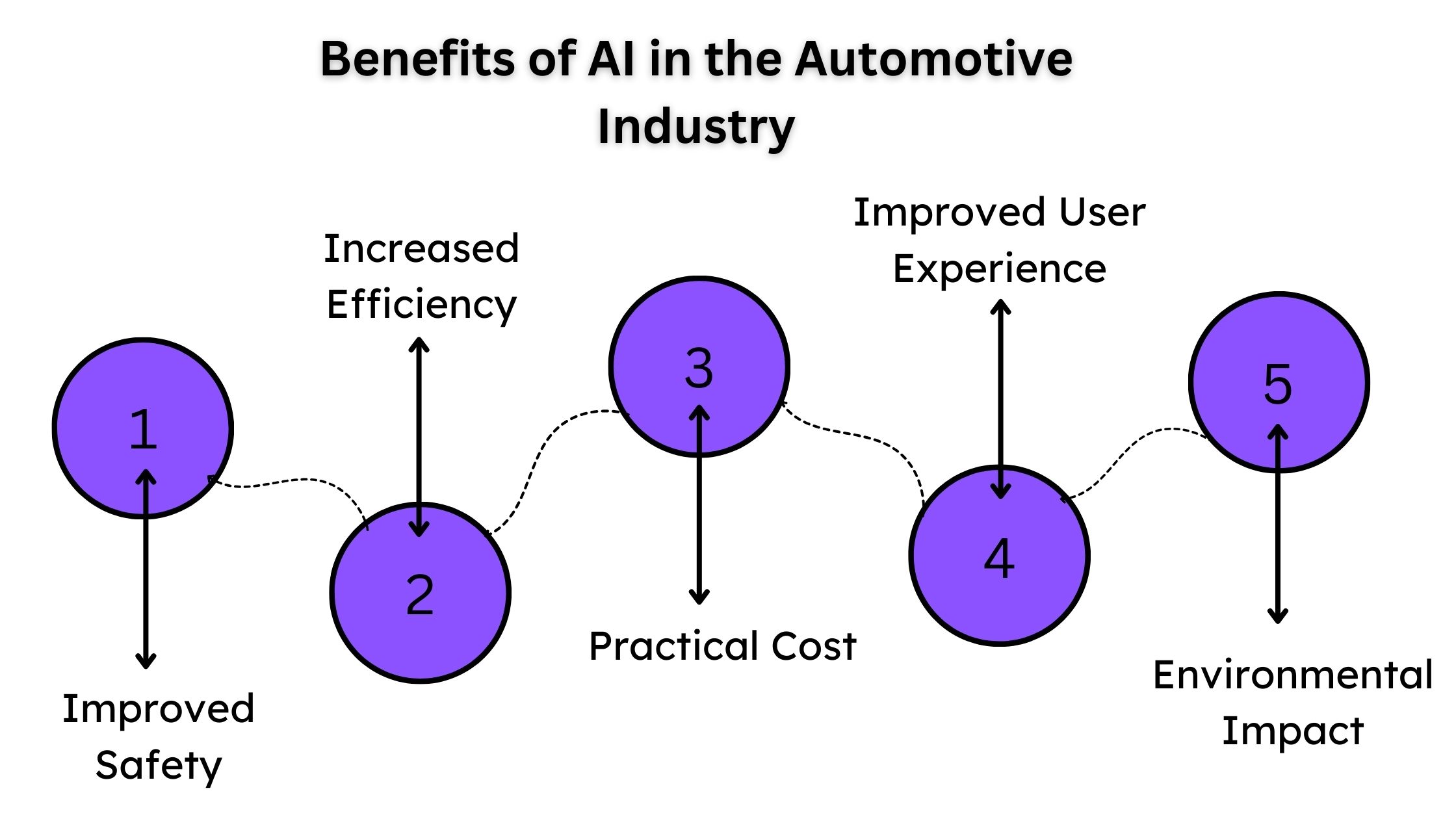
As AI reshapes the world, industries everywhere use its potential, transforming processes in ways that once thought unimaginable. Businesses are shifting towards the usage of the same. The impact of AI on the automobile sector could not be highlighted enough. From self-driving cars to predictive maintenance, all have absorbed unprecedented adaptations. More than ever, IT stands for designing automobiles dreaming about developing smart, safer, and more energy-efficient systems. The manufacturing industry is on the verge of revolutionizing, which will contribute to the manufacturers, drivers, and enterprises'. It will open a series of opportunities for efficient use after the global deployment of AI technologies. This article will examine artificial intelligence technology solutions in the automobile industry, functions, and applications. The focus will also be on the future of AI in this rapidly ascending field. AI is transforming the automobile today by addressing concerns about design, manufacturing, and user experience. All important technologies of such innovation involve learning machines, systems of artificial visions, and even NLP or natural language processes. Smart Design with Machine Learning: Machine learning allows engineers to analyze large data sets, simulate real-world driving conditions, and optimize vehicle designs. Simplifying the prototyping process minimizes development time, increases efficiency, and cuts costs. Improved Manufacturing through Artificial Vision: Artificial vision systems enable AI-powered quality control, which helps identify defects in production. Automating this process ensures precision, reduces errors, and increases productivity overall. Improved Customer Experience with NLP: Natural language processing powers vehicle voice-activated systems, enabling drivers to manage navigation, entertainment, and climate settings effortlessly. This hands-free interaction enhances safety and convenience. AI is also crucial in autonomous vehicle development. It processes data from sensors and cameras, allowing vehicles to navigate safely and make real-time decisions. Additionally, AI optimizes manufacturing workflows, predicts maintenance needs, and enhances supply chain efficiency. By integrating AI, the automotive industry is advancing toward safer, smarter, and more sustainable transportation, redefining mobility and customer satisfaction. 1. Autonomous Driving Over the last few decades, artificial intelligence has made complete autonomous driving possible. AI systems can understand the vehicle's surroundings and reasonably predict obstacles. They also use complex algorithms and sensors to make daily driving decisions. Thus, eliminating human errors remains the top priority in road accidents and promoting safety. Self-driving cars bring smarter transportation and even become an efficient means of mobility. AI-enabled self-driving cars use sensors (cameras, radar, LiDAR) to survey their environment. Systems make decisions on steering, braking, and acceleration without human intervention. Examples are the Tesla Autopilot and self-driving cars from Waymo. 2. Predictive Maintenance It uses artificial intelligence to identify the health level of vehicle engines, tires, and brakes. It uses IoT sensors, which collect data as they operate under various temperature, pressure, and acceleration conditions. The processed data from sensor collection analyzes patterns and predicts exactly when a piece of equipment in the vehicle will likely fail ahead of time, thus enabling proactive scheduled maintenance. This is how AI works: AI analyzes sensor data from various vehicle components for signs of wear and failure. Alerts may be triggered to drivers or fleet managers, enabling them to attend to parts well before breaking down. This helps reduce repair costs and unexpected breakdowns. 3. Driver Monitoring Systems (DMS) Driver Monitoring Systems use AI to analyze a driver's current state. With facial recognition and motion sensors, AI can detect drowsiness or distraction. These systems mitigate accidents by alarming drivers or taking corrective measures, such as controlling speed during driver fatigue. The AI-based systems identify the presence of fatigue, distraction, or drowsiness in drivers. This type uses facial recognition and motion sensors to monitor the driver's behavior. Alerts are given so that the driver remains vigilant or takes some rest. 4. ADAS(Advanced Driver Assistance Systems) AI is the basis of ADAS. Today, this technology enables driver assistance through accident-avoiding technologies. Real-time information from cameras and sensors triggers the AI system into automatic functions, such as braking or steering changes, upon a perceived risk of collision. Such systems also help protect drivers from accidents, especially on highways. Safety features include lane departure warning, automatic braking, and adaptive cruise control with AI assistance. Corrective actions are processed in real-time in critical situations. Prevents accidents through support rendered by the driver when required. Artificial Intelligence is revolutionizing vehicle manufacturing by automating tasks traditionally performed by humans. Robotic and AI systems perform repetitive tasks, such as welding and assembly, to enhance precision and speed. In addition, AI algorithms help improve real-time multi-stage quality control by identifying manufacturing defects or problems during production. Producing high-quality products increases producers' productivity and lowers costs, which companies and consumers alike can benefit from. AI automates repetitive tasks in the manufacturing process, which enhances efficiency. It improves quality monitoring by finding defects in real-time. Optimizes supply chain and inventory control. 6. Personal Infotainment System Article Another application of AI in the automotive industry is the infotainment experience, which is personalized to each user. Over time, it learns the driver's habits, making adjustments conducive to particular conditions, like the selection of music, climate control, or navigation adjustments. Integration with voice assistants lets you perform tasks completely hands-free, making driving easier and more enjoyable. In-dash systems offer personalized recommendations that enhance the in-car experience for drivers and passengers alike. Provides a learning element about the driver's music preferences, temperature, navigation, etc. Recommendations are personalized by automatically adjusting settings based on relevance to the preferences of the driver and passenger. It's accessible via voice assistants such as Alexa or Siri with hands-free control. 7. Traffic Management and Route Optimization AI systems analyze real-time traffic conditions, accidents, and road closures to suggest the best possible routes. This will reduce travel time and avoid traffic jams, saving fuel and emissions. In fleet management by businesses, AI optimizes delivery routes, enhancing operational efficiency and reducing costs. Overall, these systems contribute to more eco-friendly and efficient transportation. AI studies real-time traffic data to optimize driving routes. Reduces travel time, fuel consumption, and emissions. It is ideal for city driving and logistics companies. 8. Fleet Management AI improves fleet management by providing real-time data on vehicle conditions, driving patterns, and operational performance. Based on feedback, AI-based software can improve routes, minimize fuel intake, and enhance driver performance. Predictive maintenance algorithms ensure that fleet vehicles are always well maintained, reducing the rate of sudden breakdowns and enabling efficient fleet operation. The AI-based tool scans the car's performance, driver behavior, and fuel utilization. Helps optimize routes and manage schedules. Predicts vehicle maintenance needs to avoid breakdowns. 9. Vehicle Insurance Optimization For one, AI in the insurance industry creates more personalized policies. AI evaluates the driver's risk profile and proffers a tailored premium to such individuals by tracking all drivers' behaviors, including speed, braking habits, and routes. This provokes fair pricing while encouraging safer driving and enables the company to use real-time data in better risk assessment processes to benefit consumers and insurers. AI assesses driving patterns, determines the level of risk, and accordingly adjusts the premium. Promotes safe driving: The system awards good behavior through lower premiums. More accurate pricing: Based on actual driving data rather than conventional metrics, offers more precise pricing. 10. The vehicle design and prototyping AI in vehicle design entails simulating several driving conditions and a virtual test of newly proposed items. It allows manufacturers to optimize vehicle parts for safety, efficiency, and performance before creating a prototype. AI expedites design development and reduces the time and cost incurred by following traditional prototype techniques. Thus, car manufacturers can launch their new concepts and designs much sooner into the market. AI enables the simulation of scenarios whereby virtual prototypes are created instead of having multiple physical models. AI optimizes design for the areas of performance, safety, and efficiency. It reduces the development time and gets new models to the market faster. Here are some of the advantages of the usage of AI in the automotive industry: Improved Safety AI systems, including ADAS and driver monitoring, significantly reduce the risk of accidents. By reacting to potential dangers faster than human drivers, AI saves lives and prevents injuries. Increased Efficiency AI also saves manufacturing costs by optimizing production lines and quality control processes. Practical Cost The predictive approach prevents expensive breakdowns and increases vehicle lifetimes. AI in manufacturing also reduces waste and operational inefficiencies. Improved User Experience From infotainment systems tailored to individual preferences to intuitive vehicle controls, AI offers a seamless and enjoyable driving experience custom-fit to a person's needs. Environmental Impact AI helps optimize routes and develop the automotive industry's carbon footprint vehicles and energy production. The impact of AI in the automotive industry is producing energy-efficient products by reducing the carbon footprint of the automotive industry. Improved Fleet Management AI-powered fleet tools help improve logistics, reduce operational costs, and ensure timely deliveries for fleet-based businesses. The future of AI is extremely promising, especially in the automotive industry. Since AI technology develops continuously, completely autonomous vehicles and many other improvements will be popular. AI can enhance vehicle connectivity, integrate vehicles within smart city infrastructure, and work towards sustainable, eco-friendly modes of transportation. New technologies like quantum computing and 5G will amplify AI's capabilities in this sector. They will allow real-time data processing and decision-making. Electric and autonomous vehicles will dominate the roads, making transportation safer, more efficient, and environmentally friendly. AI is revolutionizing the automation sector, changing the industry for the better. It has transformed what driving feels like and changed how people connect with vehicles. AI is still broadening its focus on safety, mostly improving operational efficiency. The impact of AI in the automotive industry will dictate the future of mobility. It moves with AI innovation here at Aress. We ensure our clients can successfully navigate the transition journey by integrating AI into processes or enhancing efficiency in cars and other car abilities. Are you ready to open the automotive future with AI? Contact us now and drive off into the dawn of automotive brilliance.Artificial Intelligence in the Automotive Industry
Top 10 Uses of AI in the Automotive Industry
5. AI in Vehicle ManufacturingBenefits of AI in the Automotive Industry
Future of Artificial Intelligence in Automotive
Conclusion
 Few
More from
Administrator
Few
More from
Administrator
Category: Digital
Recent Posts
-
Salesforce
Aress showcases Salesforce delivery strength as Explorer Sponsor at Salesforce World Tour Essentials Sydney
-
Digital
From Vulnerability Management to Threat Detection: Building a Continuous VAPT Program for the Enterprise
-
Digital
AI vs AI: How Enterprises Can Defend Against the New Generation of AI-Powered Cyberattacks
-
Digital
Cybersecurity Awareness Month 2026: How to Benchmark Your Enterprise Security Posture
-
Digital
Cybersecurity Awareness Month 2026: What Should Be on Every Enterprise Security Checklist?