 +91 253 6630710
 781.258.1274
 +44 (0) 7446 87 37 97
How to Turn a Lovable App into a Production-Ready SaaS Platform


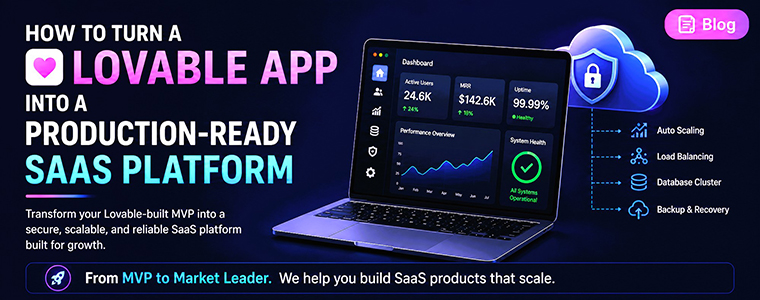

How to Turn a Lovable App into a Production-Ready SaaS Platform
AI-powered development tools like Lovable are transforming how startups build software. Founders can now create functional applications in days rather than months, validate ideas faster, and bring products to market with significantly lower upfront investment.
Blog Highlights
- Learn why most Lovable-generated MVPs or any vibe coded apps need engineering before launch
- Discover common security gaps and scalability challenges in AI-generated applications
- Understand the importance of AI-generated code review and software quality assurance
- Explore best practices for secure software development
- Follow a production-readiness checklist for scaling your SaaS platform
For many startups, this is a game changer.
However, there is an important distinction every founder should understand:
A working MVP is not the same as a production-ready SaaS platform.
While vibe coding platforms like Lovable can help you rapidly build and launch an application, most AI-generated products require additional engineering before they can support real users at scale. Security vulnerabilities, database performance issues, architectural limitations, and testing gaps often remain hidden until the application starts growing.
The reality is simple: AI can generate code, but engineering transforms that code into a reliable business platform.
In this guide, we'll explore the key steps required to move from a Lovable-generated MVP to a secure, scalable, production-ready SaaS application.
Why Lovable Is Great for MVP Development
Lovable has become popular because it dramatically accelerates product development.
Key benefits include:
- Rapid prototyping
- Faster product validation
- Reduced development costs
- Quicker feedback from users
- Shorter time-to-market
For startups trying to validate a business idea, these advantages are incredibly valuable.
However, most AI-generated applications are designed to prove a concept—not necessarily support thousands of users, sensitive customer data, or enterprise-level performance requirements.
As your user base grows, weaknesses that were invisible during development often begin to emerge.
Security Gaps Hidden Inside AI-Generated Applications
Security is one of the most overlooked risks in AI-generated software.
Many founders assume that if an application works correctly, it must also be secure. Unfortunately, that's rarely the case.
Common security gaps found during audits include:
- Weak authentication mechanisms
- Exposed API endpoints
- Hardcoded credentials
- Missing encryption controls
- Insufficient role-based access management
- Insecure third-party integrations
These vulnerabilities can expose customer data, create compliance risks, and damage trust.
Before launching your application, it is essential to conduct a comprehensive security assessment and implement secure software development practices.
Organizations that invest in professional AI consulting services and security reviews can identify vulnerabilities early and reduce future risks.
Questions Founders Should Ask
- Are user passwords securely stored?
- Is sensitive data encrypted?
- Are APIs protected from unauthorized access?
- Can the application withstand common cyberattacks?
If the answer to any of these questions is uncertain, additional security engineering is needed before launch.
Database Bottlenecks That Appear as User Growth Increases
A database that performs well for 50 users may struggle significantly when supporting 5,000 users.
This is one of the most common challenges seen in AI-generated applications.
Typical database issues include:
- Poor schema design
- Missing indexes
- Inefficient queries
- Duplicate data structures
- Performance bottlenecks
- Data consistency problems
As transaction volumes increase, these issues can cause:
- Slow page loads
- Failed transactions
- User frustration
- Increased infrastructure costs
To prepare for growth, engineering teams often optimize:
- Database architecture
- Query performance
- Data storage models
- Caching strategies
- Backup and recovery systems
A scalable SaaS platform requires a strong foundation at the data layer.
Poor Architecture Can Limit Future Growth
Many AI-generated applications are optimized for speed of development rather than long-term maintainability.
While this approach helps founders launch quickly, it can create challenges later.
Common architectural problems include:
- Tight coupling between components
- Monolithic codebases
- Poor separation of concerns
- Limited scalability
- Difficult integrations
These issues can make future enhancements expensive and time-consuming.
As a product evolves, teams often need to:
- Refactor application components
- Improve API architecture
- Introduce modular services
- Enhance maintainability
- Support future integrations
Strong software architecture enables businesses to scale efficiently while reducing technical debt.
Scalability Issues Most Founders Don't See Coming
A successful SaaS platform must be prepared for growth.
Unfortunately, many MVPs are not designed to handle:
- Large traffic spikes
- High transaction volumes
- Concurrent users
- Background processing jobs
- Enterprise workloads
Without proper planning, performance issues can emerge quickly.
Common scalability improvements include:
Infrastructure Optimization
- Cloud-native deployment
- Auto-scaling resources
- Load balancing
- Distributed services
Application Performance
- Caching strategies
- Asynchronous processing
- Database optimization
- API performance tuning
Operational Visibility
- Monitoring dashboards
- Application logging
- Real-time alerting
- Performance analytics
Scalability should not be treated as an afterthought. It must be built into the platform from the beginning.
Why Every Lovable App Needs an AI-Generated Code Review
AI-generated code can dramatically accelerate development, but speed should never replace quality.
A professional AI-generated code review helps identify issues that may not be immediately visible.
During a code review, engineers evaluate:
- Code quality
- Security vulnerabilities
- Performance inefficiencies
- Maintainability concerns
- Technical debt
- Scalability risks
Benefits of AI-generated code review include:
- Improved software reliability
- Reduced security risks
- Better long-term maintainability
- Lower future development costs
- Increased confidence before launch
Think of a code review as a health check for your application before it enters production.
Secure Software Development Best Practices
Security should be integrated throughout the development lifecycle rather than added after launch.
Modern SaaS platforms follow secure software development practices such as:
DevSecOps
Security integrated into development and deployment workflows.
Secure CI/CD Pipelines
Automated testing and validation before deployment.
Vulnerability Management
Continuous scanning for security weaknesses.
Access Controls
Role-based permissions and least-privilege access.
Data Protection
Encryption for data in transit and at rest.
Compliance Readiness
Support for industry regulations and security standards.
These practices are particularly important for industries such as:
- Healthcare
- BFSI
- FinTech
- SaaS
- E-commerce
Software Quality Assurance Is Essential for Production Readiness
One of the biggest mistakes startups make is assuming that a working application has been adequately tested.
Software quality assurance goes far beyond checking whether features function correctly.
A comprehensive QA strategy includes:
Functional Testing
Verifies that application features work as expected.
Integration Testing
Ensures systems communicate correctly.
Performance Testing
Measures application responsiveness under load.
Load Testing
Simulates real-world user traffic.
Security Testing
Identifies vulnerabilities before deployment.
Regression Testing
Ensures new updates do not break existing functionality.
Investing in software quality assurance helps prevent costly production failures and improves user satisfaction.
Production Readiness Checklist for Lovable Apps
Before launching your SaaS platform, review the following checklist:
Architecture
- Modular application design
- Clean API architecture
- Maintainable codebase
Security
- Secure authentication
- Data encryption
- Vulnerability testing
- Access controls
Database
- Query optimization
- Indexing strategy
- Backup and recovery planning
Infrastructure
- Cloud scalability
- Load balancing
- Monitoring systems
DevOps
- Automated deployments
- CI/CD implementation
- Environment management
Quality Assurance
- Functional testing
- Performance testing
- Security testing
- Regression testing
If any item remains incomplete, additional engineering work may be necessary before production deployment.
How Aress Helps Transform AI-Built MVPs into Production SaaS Platforms
Many startups successfully build MVPs using AI-powered tools but require additional expertise to prepare for growth.
Aress helps organizations bridge the gap between prototype and production through:
- Software Engineering
- Cloud Application Development
- DevOps and Automation
- Cyber Security Services
- Application Modernization
- Software Quality Assurance
- AI Consulting Services
Our team helps founders transform AI-generated applications into scalable, secure, enterprise-ready SaaS platforms that support long-term business growth.
Whether you're facing scalability challenges, security concerns, or architectural limitations, the right engineering strategy can turn a promising MVP into a successful software product.
Final Thoughts
Building with Lovable is an excellent way to validate an idea and accelerate innovation.
But launching a successful SaaS business requires more than functional code.
To become production-ready, your application must be:
- Secure
- Scalable
- Maintainable
- Well-tested
- Cloud-ready
The most successful startups understand that AI accelerates development, while software engineering ensures long-term success.
If you've built an MVP using Lovable or another AI development platform, now is the time to evaluate whether your application is ready for real-world growth.

 Few
More from
Kiran Vidhate
Few
More from
Kiran Vidhate
Category: Digital
Recent Posts
-
Salesforce
Aress showcases Salesforce delivery strength as Explorer Sponsor at Salesforce World Tour Essentials Sydney
-
Digital
From Vulnerability Management to Threat Detection: Building a Continuous VAPT Program for the Enterprise
-
Digital
AI vs AI: How Enterprises Can Defend Against the New Generation of AI-Powered Cyberattacks
-
Digital
Cybersecurity Awareness Month 2026: How to Benchmark Your Enterprise Security Posture
-
Digital
Cybersecurity Awareness Month 2026: What Should Be on Every Enterprise Security Checklist?