 +91 253 6630710
 781.258.1274
 +44 (0) 7446 87 37 97
CloudOps vs DevOps vs SRE: What MSPs and Enterprises Get Wrong


CloudOps vs DevOps vs SRE: What MSPs and Enterprises Get Wrong
Why CloudOps, DevOps, and SRE Are Often Confused
Modern cloud environments blur traditional boundaries. Continuous deployments, distributed systems, and 24×7 availability expectations have forced development and operations teams closer together.
As a result:
- DevOps teams are expected to manage production incidents.
- CloudOps teams are reduced to monitoring and ticket handling.
- SRE is added without clearly defined ownership or goals.
This leads to reactive operations, tool sprawl, unreliable uptime, and uncontrolled cloud spend.
To fix this, organizations must clearly understand the role of each model.
What Is DevOps Really Meant to Do?
DevOps is primarily focused on speed and collaboration. It's goal is to streamline the software delivery lifecycle by aligning development and operations teams.
DevOps strengths include:
- CI/CD pipelines and release automation.
- Faster time to market.
- Infrastructure as Code (IaC).
- Improved developer productivity.
Where DevOps falls short:
DevOps is not designed to own 24×7 cloud operations, cost optimization, or long-term reliability. When DevOps teams are forced into constant firefighting, innovation slows and technical debt increases.
Key Takeaway: DevOps enables speed—but not operational stability on it's own.
CloudOps: The Missing Layer in Cloud Operations
CloudOps focuses on running and optimizing cloud environments after deployment. It ensures applications remain secure, performant, and cost-efficient in production.
Key CloudOps responsibilities include:
- 24×7 monitoring and availability management.
- Performance and capacity optimization.
- Security and compliance enforcement.
- Cloud cost governance and FinOps alignment.
- Incident, problem, and change management.
A common misconception is that CloudOps is “just monitoring.” In reality, CloudOps is a full operational discipline that combines people, processes, and automation.
Without mature CloudOps, organizations experience:
- Escalating cloud bills.
- Inconsistent application performance.
- Reactive incident response.
Key Takeaway: CloudOps ensures runtime stability, security, and cost control at scale.
What Makes SRE Different from DevOps and CloudOps?
Site Reliability Engineering (SRE) applies software engineering principles to operations. Instead of reacting to incidents, SRE focuses on preventing them through design and automation.
Core SRE practices include:
- Defining SLIs (Service Level Indicators) and SLOs (Service Level Objectives).
- Using error budgets to balance speed and reliability.
- Automating repetitive operational tasks.
- Reducing Mean Time to Recovery (MTTR).
SRE is often misunderstood as an advanced form of DevOps. In reality, SRE complements both DevOps and CloudOps by introducing measurable reliability.
When SRE is implemented without clarity, it becomes a reporting function rather than a reliability driver.
Key Takeaway: SRE engineers reliability using metrics, automation, and error budgets.
The Biggest Mistake: Expecting One Model to Do Everything
The most common operational failure occurs when organizations expect a single model to deliver:
- Speed
- Stability
- Reliability
In practice:
- DevOps without CloudOps leads to unstable production.
- CloudOps without SRE leads to reactive firefighting.
- SRE without DevOps slows innovation.
High-performing MSPs and enterprises do not choose between CloudOps, DevOps, and SRE. They align them.
What an Aligned Cloud Operating Model Looks Like
Successful cloud organizations clearly define responsibilities:
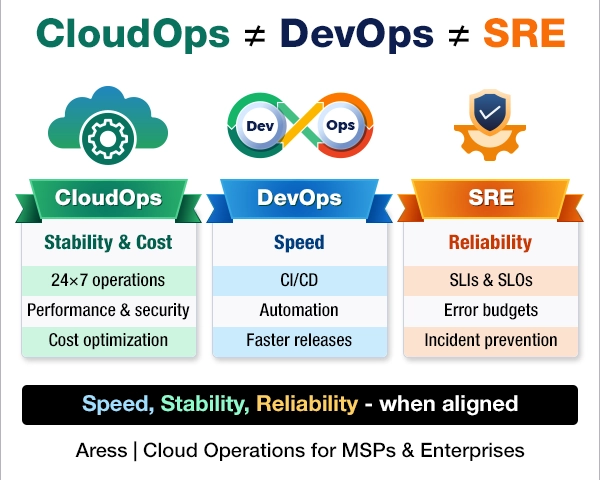
- DevOps → Speed, automation, continuous delivery.
- CloudOps → Stability, security, cost optimization.
- SRE → Reliability, resilience, measurable outcomes.
This alignment allows organizations to:
- Innovate faster without sacrificing uptime.
- Control cloud costs predictably.
- Reduce operational noise and incident fatigue.
For MSPs, this alignment transforms service delivery from reactive support to strategic cloud operations management.
How Aress Helps MSPs and Enterprises Get CloudOps Right
Aress helps MSPs and enterprises design and operate scalable CloudOps frameworks that integrate seamlessly with DevOps pipelines and SRE practices.
Our CloudOps approach focuses on:
- Cloud operations maturity models.
- Automation without tool overload.
- Embedded cloud cost governance.
- Reliability metrics that drive action.
For MSPs, this enables higher margins, stronger SLAs, and long-term client retention.
For enterprises, it ensures innovation scales without compromising performance or customer experience.
Final Thought
CloudOps, DevOps, and SRE are not competing models. They are complementary capabilities that solve different problems.
Organizations that understand this distinction gain a measurable advantage in cloud reliability, operational efficiency, and cost control.
If your teams are still relying on one model to deliver every outcome, it may be time to rethink your cloud operations strategy.
Our team of MSP experts can help you identify inefficiencies, reduce unnecessary spend, and restore operational clarity.
 Few
More from
Administrator
Few
More from
Administrator
Category: 24x7 Technical Support
Recent Posts
-
Salesforce
Aress showcases Salesforce delivery strength as Explorer Sponsor at Salesforce World Tour Essentials Sydney
-
Digital
From Vulnerability Management to Threat Detection: Building a Continuous VAPT Program for the Enterprise
-
Digital
AI vs AI: How Enterprises Can Defend Against the New Generation of AI-Powered Cyberattacks
-
Digital
Cybersecurity Awareness Month 2026: How to Benchmark Your Enterprise Security Posture
-
Digital
Cybersecurity Awareness Month 2026: What Should Be on Every Enterprise Security Checklist?