 +91 253 6630710
 781.258.1274
 +44 (0) 7446 87 37 97
Cybersecurity Awareness Month 2026: What Should Be on Every Enterprise Security Checklist?


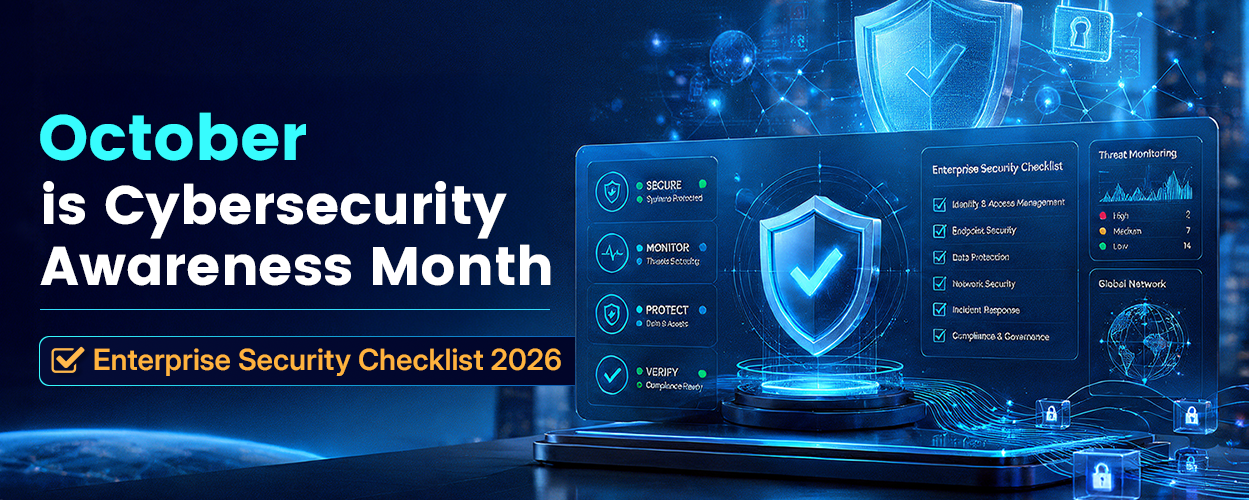

Cybersecurity Awareness Month 2026: What Should Be on Every Enterprise Security Checklist?
Every October, Cybersecurity Awareness Month gives enterprises a reason to pause and ask an uncomfortable question: if we were targeted tomorrow, would our defenses actually hold?
For most organizations, the honest answer sits somewhere between "we think so" and "we're not entirely sure." Threat actors do not wait for a convenient audit cycle, and a checklist that lived in a slide deck a year ago is rarely the checklist that matters today. As AI accelerates both attack techniques and the sheer volume of exploitation attempts, enterprise security teams need a working checklist they can actually execute against, not a compliance formality.
Quick Answer:
A strong 2026 enterprise security checklist covers eight areas: Governance and risk ownership, identity and access management, structured vulnerability assessment and penetration testing (VAPT), application security across web, mobile and API layers, cloud security configuration, network segmentation and monitoring, human risk and phishing resilience, and incident response readiness. The checklist is only complete once every finding has been re-tested and closed, not just reported.
Below is the full breakdown, along with what we typically see when we run these assessments for enterprise clients.
1 Governance and Risk Ownership
Security checklists fail most often not because a control is missing, but because no one owns it.
Before touching tools or technology, enterprises should confirm:
- A current, accurate inventory of digital assets: applications, APIs, servers, cloud resources and third-party integrations
- A named owner for each critical system's security posture
- A documented risk assessment cadence, not a one-time exercise
- Compliance mapping against relevant frameworks (PCI DSS, ISO 27001, GDPR or sector-specific mandates) tied to actual business risk, not just audit checkboxes
2 Identity and Access Management
Compromised credentials remain one of the fastest paths into an enterprise environment.
The checklist here should confirm:
- Multi-factor authentication enforced across all privileged and remote access points
- Least-privilege access reviewed on a fixed schedule, not left to accumulate
- Session management and timeout policies tested, not assumed
- Privileged access management (PAM) in place for admin and service accounts
3 Structured Vulnerability Assessment and Penetration Testing (VAPT)
This is where most checklists become aspirational rather than operational. A vulnerability assessment tells you where the weaknesses are; penetration testing tells you what an attacker could actually do with them. Both are necessary, and neither replaces the other.
An enterprise-grade VAPT checklist should include:
- Planning and scoping that clearly defines systems, networks and applications in scope
- Reconnaissance to map potential attack vectors specific to the target environment
- Vulnerability assessment using both automated scanning tools and manual analysis, since automated scanners alone consistently miss business logic flaws
- Penetration testing that simulates real-world attack scenarios rather than theoretical ones
- Severity-based reporting (critical, high, medium, low) with clear remediation guidance
- A report walkthrough with the client team, not just a PDF left unread
- Patching against the documented recommendations
- Re-testing to confirm vulnerabilities were actually closed, not just marked resolved
- Final report submission that becomes part of the compliance and audit record
Testing should be aligned to recognized standards, including the OWASP Top 10, OSSTMM, SANS Top 25, NIST SP800-115 and CIS Benchmarks, rather than an internally invented methodology that cannot be benchmarked externally.
4 Application Security Across Every Layer
Enterprise attack surfaces rarely stop at the website.
The checklist should extend to:
- Web application security testing (injection flaws, authentication bypass, session handling)
- Mobile application security testing (insecure storage, weak API calls, reverse engineering risk)
- API security testing, since APIs are increasingly the primary integration point and a common blind spot
- Thick client application security for legacy or specialized enterprise software
- IoT security testing wherever connected devices touch the corporate network
5 Cloud Security Configuration
Cloud misconfigurations are now one of the most common causes of enterprise data exposure, and they are almost entirely preventable. A recent industry case is instructive: A fast-growing e-commerce company suffered a significant breach when a cloud storage bucket, left publicly accessible due to a misconfiguration during migration, exposed customer names, addresses, card numbers and purchase histories. The failure was not a lack of security tools. It was the absence of a routine configuration audit and adequate monitoring.
The checklist should require:
- Regular cloud security audits across AWS, Azure and GCP environments
- Access controls built on least-privilege principles for every storage resource
- Continuous monitoring and logging to detect unusual access patterns early
- Verification that no storage bucket, database or endpoint is publicly reachable without explicit business justification
6 Network Security
- Network segmentation to contain lateral movement if a breach occurs
- Regular network-level VAPT covering firewalls, routers and internal infrastructure
- Monitoring tuned to detect anomalies, not just log them for later review
7 Human Risk and Phishing Resilience
Technology controls cannot compensate for an untrained workforce. Enterprises should run:
- Periodic phishing simulation exercises, not a single annual test
- Security awareness training tied to real findings from those simulations
- Clear, simple reporting paths so employees flag suspicious activity instead of ignoring it
8 Incident Response and Forensic Readiness
The organizations that recover fastest from a breach are the ones that had a plan before the breach happened. In one engagement, an investment consultancy firm suspected a breach on one of its servers; a structured forensic analysis of logs confirmed the intrusion and gave the firm's leadership concrete evidence to act on immediately. Without that forensic capability already in place, that confirmation and the resulting containment would have taken far longer.
The checklist should confirm:
- A documented, tested incident response plan with clear roles
- Log retention sufficient to support forensic analysis after the fact
- A pre-identified security partner for forensic investigation, so the first call during a breach is not "who do we even ask?"
9 Secure Development (DevSecOps)
For enterprises that build their own software, security cannot be a final gate before release. In one case, a software development company shifted from a traditional waterfall security model to DevSecOps, integrating automated static and dynamic testing (SAST, SCA, DAST) directly into its CI/CD pipeline. The result was measurable: vulnerabilities detected at the final testing stage dropped by 70%, and time to market improved by 30%, because issues were caught and fixed early rather than discovered late.
The checklist should include:
- Security testing integrated into the CI/CD pipeline, not bolted on afterward
- Regular secure-coding training for development teams
- Continuous vulnerability monitoring for deployed products, not just at release
How Aress Approaches This Checklist in Practice
At Aress, our Cybersecurity Centre of Excellence runs this checklist as a hybrid methodology: Commercial automated scanning tools combined with manual testing designed specifically to catch what automated scanners cannot, including business logic flaws, access control issues and privilege escalation paths. Our team holds credentials including OSCP, CISSP, CISA, CEH and AWS Security Specialty, and is an active participant on bug bounty platforms like HackerOne and Bugcrowd, which keeps our testing approach current against real-world attack techniques rather than static playbooks.
In one recent engagement with a fast-growing financial platform, this approach identified 18 vulnerabilities across the risk spectrum, including critical findings such as authentication bypass, account takeover and error-based SQL injection, well before they could be exploited by an outside actor. That is the outcome a checklist like this is meant to produce: not a document, but a measurably smaller attack surface.
Frequently Asked Questions
What is the single most overlooked item on enterprise security checklists?
Re-testing. Many organizations run a vulnerability assessment, receive a report, and consider the job done. Without re-testing, there is no confirmation that the patched vulnerability was actually fixed correctly.
How often should an enterprise run VAPT?
At minimum annually, and after any significant change to infrastructure, application architecture or cloud environment. High-risk sectors such as BFSI and fintech typically test more frequently.
Is automated vulnerability scanning enough on its own?
No. Automated tools are efficient at catching known vulnerability patterns but consistently miss business logic flaws, chained exploits and context-specific weaknesses that only manual testing uncovers.
Why does Cybersecurity Awareness Month matter for enterprises specifically, not just consumers?
It creates a natural, recurring checkpoint to revisit assumptions about security posture before they are tested by an actual attacker, and it gives security teams a business-wide reason to secure budget and attention for overdue assessments.
What is the fastest way to know where our organization stands right now?
A scoped vulnerability assessment and penetration testing engagement, benchmarked against OWASP, NIST and CIS standards, is the most direct way to get an evidence-based answer rather than an assumption.
Take the Next Step This Cybersecurity Awareness Month
A checklist is only useful once it has been tested against your actual environment. If it has been more than a year since your last VAPT engagement, or if your cloud environment has changed since your last audit, Cybersecurity Awareness Month is the right moment to close that gap.
Talk to an Aress Cybersecurity Expert and find out exactly where your enterprise stands before someone else does.

 Few
More from
Harish Kasture
Few
More from
Harish Kasture
Category: Digital
Recent Posts
-
Digital
Cybersecurity Awareness Month 2026: How to Benchmark Your Enterprise Security Posture
-
Digital
Cybersecurity Awareness Month 2026: What Should Be on Every Enterprise Security Checklist?
-
ServiceNow
ServiceNow Otto Explained: What the New AI Assistant Means for Enterprise Work in 2026
-
Digital
Small Business Website Security: How to Protect Your Site and Customer Data
-
Digital
How to Add LLM Features to an Enterprise Mobile App Without Rebuilding It