 +91 253 6630710
 781.258.1274
 +44 (0) 7446 87 37 97
Why Traditional QA Audits Fail at Scale in Contact Centers


Why Traditional QA Audits Fail at Scale in Contact Centers
Customer expectations have changed. Contact center complexity has exploded. But for many organizations, QA auditing hasn’t evolved at the same pace.
What once worked for small teams handling limited call volumes now struggles under the weight of omnichannel interactions, remote agents, compliance pressure, and CX accountability.
This is why traditional QA audits - especially manual, sampling-based approaches - are increasingly failing at scale.
Let’s break down where the cracks appear and why so many support leaders feel stuck.
Key Highlights
- Most contact centers audit only 1-3% of customer interactions, leaving the majority of quality issues unseen.
- Sampling-based QA audits create blind spots in customer experience, compliance, and agent performance.
- Manual QA reviews place heavy cognitive load on auditors, leading to burnout and inconsistent evaluations.
- Inconsistent scoring across auditors erodes trust in the QA process and frustrates frontline teams.
- Compliance and policy violations are often detected too late, increasing operational and regulatory risk.
- Traditional QA audits lack real-time visibility, making proactive intervention nearly impossible
- Limited data makes it difficult to identify CX trends and root causes at scale.
The Reality of QA Auditing Today
In most contact centers, QA audits are still driven by:
- Manual reviews.
- Random sampling.
- Spreadsheet-based scorecards.
- Retrospective reporting.
On paper, this seems reasonable. In practice, it creates systemic blind spots.
According to industry benchmarks:
- Most QA teams audit only 1-3% of total interactions.
- Review cycles often lag by days or weeks.
- Auditors are expected to balance speed, accuracy, and fairness - without adequate tooling.
At small scale, this is manageable.
At enterprise scale, it becomes unsustainable.
Pain Point #1: Only 1–3% of Interactions Are Audited
Let’s start with the most fundamental issue: coverage.
In a contact center handling 10,000 interactions per day, auditing even 5% would require reviewing 500 conversations daily - an unrealistic expectation for most QA teams.
As a result:
- The vast majority of interactions are never reviewed.
- Critical issues surface only when customers escalate.
- Patterns are missed because data is incomplete.
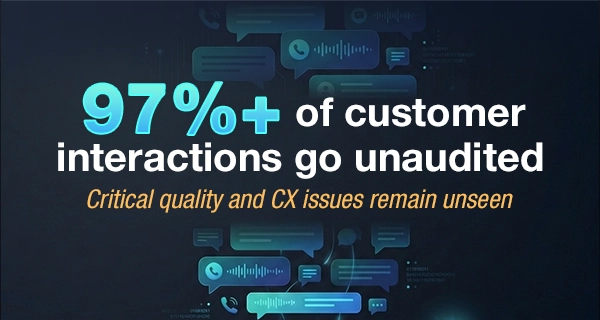
Industry studies consistently show that over 95% of customer interactions go unaudited in traditional QA models.
That means:
- Compliance violations can slip through unnoticed.
- Poor agent behaviors may persist for weeks.
- CX issues are identified reactively, not proactively.
You can’t improve what you can’t see - and sampling hides more than it reveals.
Pain Point #2: High Manual Effort Leads to Auditor Burnout
QA auditing is one of the most mentally demanding roles in customer operations.
Auditors are expected to:
- Listen to long calls or read extended chat threads.
- Apply detailed scorecards consistently.
- Interpret tone, sentiment, and intent.
- Document findings precisely for compliance.
According to workforce studies:
- QA analysts spend 60–70% of their time on repetitive review tasks.
- Many teams struggle with high attrition due to cognitive overload.
- Scaling QA often means adding headcount, not improving efficiency.
As interaction volumes grow, QA teams are forced to choose between:
- Reviewing faster (and risking accuracy).
- Reviewing less (and increasing blind spots).
Neither option is sustainable.
Pain Point #3: Inconsistent Scoring Across Auditors
Even the most experienced QA teams face a hard truth:
Human judgment varies.
Two auditors reviewing the same interaction may:
- Interpret empathy differently.
- Score compliance nuances inconsistently.
- Apply subjective criteria unevenly.
This leads to:
- Agent frustration (“Why did I score lower than my peer?”).
- Disputes and re-reviews.
- Reduced trust in the QA process.
Internal QA calibration sessions help - but they are:
- Time-consuming.
- Infrequent.
- Difficult to scale.
Without structured support, consistency erodes as teams grow.
Pain Point #4: Delayed Identification of Compliance Risks
Compliance risks don’t wait for monthly reports.
In regulated industries - finance, healthcare, telecom, insurance - even a single missed disclosure can have serious consequences.
Yet traditional QA audits often:
- Identify issues after the fact.
- Rely on post-interaction reviews.
- Lack real-time alerting mechanisms.
Industry data shows:
- Compliance issues are often detected days or weeks after occurrence.
- Organizations rely heavily on customer complaints or audits to uncover risks.
- Reactive compliance management increases regulatory exposure.
By the time an issue is flagged, the damage may already be done.
Pain Point #5: Lack of Real-Time Visibility
Modern contact centers operate in real time.
Traditional QA does not.
Most QA insights are:
- Retrospective.
- Static.
- Reported in weekly or monthly summaries.
This creates a disconnect between:
- What’s happening now.
- What leadership learns later.
Without real-time visibility:
- Supervisors can’t intervene early.
- Emerging CX issues go unnoticed.
- Coaching becomes reactive instead of proactive.
In fast-moving support environments, lagging indicators are no longer enough.
Pain Point #6: Poor CX Trend Analysis
Customer experience isn’t defined by individual interactions - it’s shaped by patterns over time.
But sampling-based QA struggles to answer questions like:
- Are customers becoming more frustrated this month?
- Which issues are driving negative sentiment?
- How does quality vary by channel or shift?
With limited data:
- Trend analysis lacks statistical confidence.
- Insights are anecdotal.
- Strategic CX decisions are made with partial information.
In an era where CX is a competitive differentiator, guesswork is costly.
The Core Problem Isn’t People - It’s the Model
It’s important to say this clearly:
Traditional QA auditing doesn’t fail because teams aren’t skilled.
It fails because the model doesn’t scale.
Manual effort, limited sampling, delayed insights, and inconsistent scoring are structural limitations, not execution issues.
This is why many organizations feel stuck between:
- Doing more audits and burning out teams.
- Doing fewer audits and accepting blind spots.
But there is a middle ground.
What Comes Next
As interaction volumes rise and expectations grow, QA auditing must evolve - without removing human judgment or increasing risk.
In the next blog, we’ll explore a common misconception:
Can automation alone fix QA auditing challenges?
 Few
More from
Administrator
Few
More from
Administrator
Category: Digital
Recent Posts
-
Salesforce
Aress showcases Salesforce delivery strength as Explorer Sponsor at Salesforce World Tour Essentials Sydney
-
Digital
From Vulnerability Management to Threat Detection: Building a Continuous VAPT Program for the Enterprise
-
Digital
AI vs AI: How Enterprises Can Defend Against the New Generation of AI-Powered Cyberattacks
-
Digital
Cybersecurity Awareness Month 2026: How to Benchmark Your Enterprise Security Posture
-
Digital
Cybersecurity Awareness Month 2026: What Should Be on Every Enterprise Security Checklist?