 +91 253 6630710
 781.258.1274
 +44 (0) 7446 87 37 97
How AIOps is Transforming Managed IT


How AIOps is Transforming Managed IT
Highlights
- AIOps applies AI and machine learning to IT operations data (logs, metrics, events, traces) to move managed IT from reactive support to predictive and proactive operations.
- In managed IT environments, AIOps reduces alert noise and incident volume by correlating thousands of signals into a small number of actionable incidents.
- AIOps works through a continuous loop of data ingestion, anomaly detection, event correlation, root-cause analysis, and automated remediation.
- The four core pillars of AIOps are big-data processing, intelligent analytics, event correlation with RCA, and automation/orchestration.
- Real-world AIOps use cases in ITSM include intelligent alerting, auto-RCA, predictive capacity planning, automated incident resolution, and enriched ITSM ticket workflows.
- Key benefits of AIOps include lower MTTR, reduced downtime, improved engineer productivity, lower operational costs, and consistent service quality at scale.
- The future of AIOps in managed IT points toward end-to-end automation, explainable AI, cross-domain correlation (Ops + Security), and business-impact driven operations.
- AIOps enables MSPs to scale without linear headcount growth, making it critical for supporting hybrid, multi-cloud, and distributed IT environments.
- Aress leverages AIOps to deliver proactive IT services, using AI-driven monitoring, dynamic baselining, automated playbooks, and business-aligned prioritization to prevent incidents before they impact users.
- For MSPs and enterprises, AIOps is no longer optional - it is the foundation for predictable operations, fewer incidents, and faster resolution.
How AIOps is Transforming Managed IT
Artificial Intelligence for IT Operations (AIOps) is no longer a futuristic concept - it’s the backbone of modern managed IT. By combining big data, machine learning and automation, AIOps lets service providers move from reactive firefighting to proactive, predictive operations that scale. In managed IT environments this shift reduces downtime, slashes mean time to resolution (MTTR), and improves customer experience while keeping operating costs under control.
What is AIOps in Managed IT?
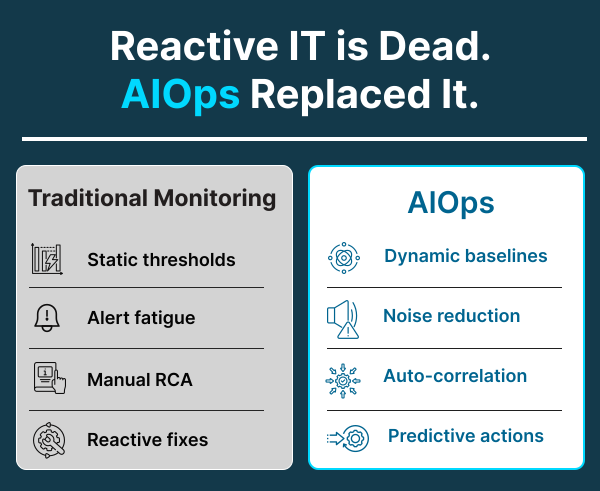
AIOps refers to applying AI/ML and analytics to the massive streams of telemetry produced across networks, clouds, endpoints and applications. Instead of relying on static thresholds and manual correlation, AIOps ingests logs, metrics, traces and events; finds patterns; detects anomalies; and surfaces the most meaningful incidents for human teams - or automates remediation end-to-end. In managed IT this means one platform can unify alerts from many monitoring tools and provide a single source of truth for MSPs and enterprise ops teams.
How AIOps Works
At a high level AIOps pipelines follow three stages: data collection and normalization, intelligent analysis, and action/automation. Data from monitoring systems is normalized into a common model; ML models and statistical methods then detect anomalies, correlate related events, and perform root-cause analysis (RCA); finally, automated playbooks or runbooks trigger remediation, ticket creation or prioritized escalations. Event correlation and dynamic baselining are core capabilities that compress incident timelines and reduce alert fatigue.
The 4 Pillars of AIOps
Different vendors phrase these slightly differently, but most AIOps implementations rest on four practical pillars:
- Data & Big-Data Processing - scalable ingestion, storage and normalization of logs, metrics, traces and events.
- Anomaly Detection & Analytics - ML models that establish dynamic baselines and flag deviations.
- Event Correlation & Root-Cause Analysis - grouping related alerts into actionable incidents and identifying causal chains.
- Automation & Orchestration - automated remediation, ticketing, and workflow integration to close the loop.
Together these pillars let MSPs handle scale and complexity without linear increases in headcount.
Real-World Use Cases in IT Service Management
AIOps powers many practical managed IT scenarios:
- Intelligent Alerting & Noise Reduction: correlate thousands of alerts into a handful of incidents so engineers focus on what matters.
- Auto-RCA & Faster MTTR: automatically surface likely root causes (e.g., a failed database node causing application errors).
- Predictive Capacity & Performance Planning: forecast capacity bottlenecks before users see degradation.
- Automated Incident Remediation: run automated playbooks for known failure modes (restart services, scale instances, reconfigure routing).
- Improved ITSM Workflows: auto-create, enrich and route tickets with context (logs, topology, probable cause), speeding resolution and reducing MTTI/MTTR.
Key Benefits of AIOps
Adopting AIOps in managed IT delivers measurable business outcomes:
- Reduced downtime and faster resolution through automated correlation and RCA, lowering MTTR.
- Lower operational costs by enabling leaner teams to manage more complex estates.
- Fewer false positives and better prioritization so engineers spend time on high-value problems.
- Predictive problem avoidance via forecasting and anomaly detection.
- Knowledge retention and standardisation as ML codifies tribal knowledge into repeatable actions.
Future of AIOps in Managed IT - backed by data & trends
AIOps adoption is accelerating as managed services move into hybrid multi-cloud environments and telemetry volumes explode. Analysts and vendors predict AIOps will evolve from “alert management” to full lifecycle automation: proactive remediation, continuous optimization, and even business-level impact modeling (showing how infrastructure events affect revenue or SLAs). Recent industry analyses emphasize these shifts: platforms will focus on explainable AI, cross-domain correlation (security + ops), and tighter integrations with ITSM and observability stacks. These trends mean MSPs that embrace AIOps can offer differentiated SLAs and predictable operations at scale.
How Aress Uses AIOps for Proactive IT Services
At Aress, AIOps is embedded into our 24×7 managed and cloud operations to deliver proactive IT outcomes - not just ticket closure. We aggregate telemetry across client environments, apply dynamic baselining and ML-driven anomaly detection, and run automated playbooks for common incident classes. That approach lets us: prioritize incidents with business context, reduce false positives, and remediate many issues automatically before users notice them. Coupled with our ISO-certified delivery and predictable operations model, AIOps helps Aress provide fewer incidents, faster resolution and scalable operations for MSPs, ISVs and enterprise customers.
AIOps is the operational multiplier for modern managed IT: it turns noise into signal, guesswork into data, and reactive work into proactive service. For MSPs and enterprises that want predictable operations, measurable SLAs and lower operational overhead, AIOps isn’t optional - it’s essential.
If you’d like, Aress can assess where AIOps will deliver the fastest ROI in your environment and propose a phased plan to modernize your monitoring and operations stack.
Would you like a short audit checklist to see where AIOps will help your environment most?
 Few
More from
Administrator
Few
More from
Administrator
Category: GenAI & Data Engineering
Recent Posts
-
Salesforce
Aress showcases Salesforce delivery strength as Explorer Sponsor at Salesforce World Tour Essentials Sydney
-
Digital
From Vulnerability Management to Threat Detection: Building a Continuous VAPT Program for the Enterprise
-
Digital
AI vs AI: How Enterprises Can Defend Against the New Generation of AI-Powered Cyberattacks
-
Digital
Cybersecurity Awareness Month 2026: How to Benchmark Your Enterprise Security Posture
-
Digital
Cybersecurity Awareness Month 2026: What Should Be on Every Enterprise Security Checklist?